Expression Number 22 for men and women: meaning, characteristics, compatibilityTurn the blueprint into a building
Your Expression Number 22 is calculated from your full name, and it points not to what you want but to what you do better than almost anyone: take an idea so large that other people's hands drop to their sides, and carry it all the way down to something material — a building, an organization, a system that keeps running without you.
The essentials
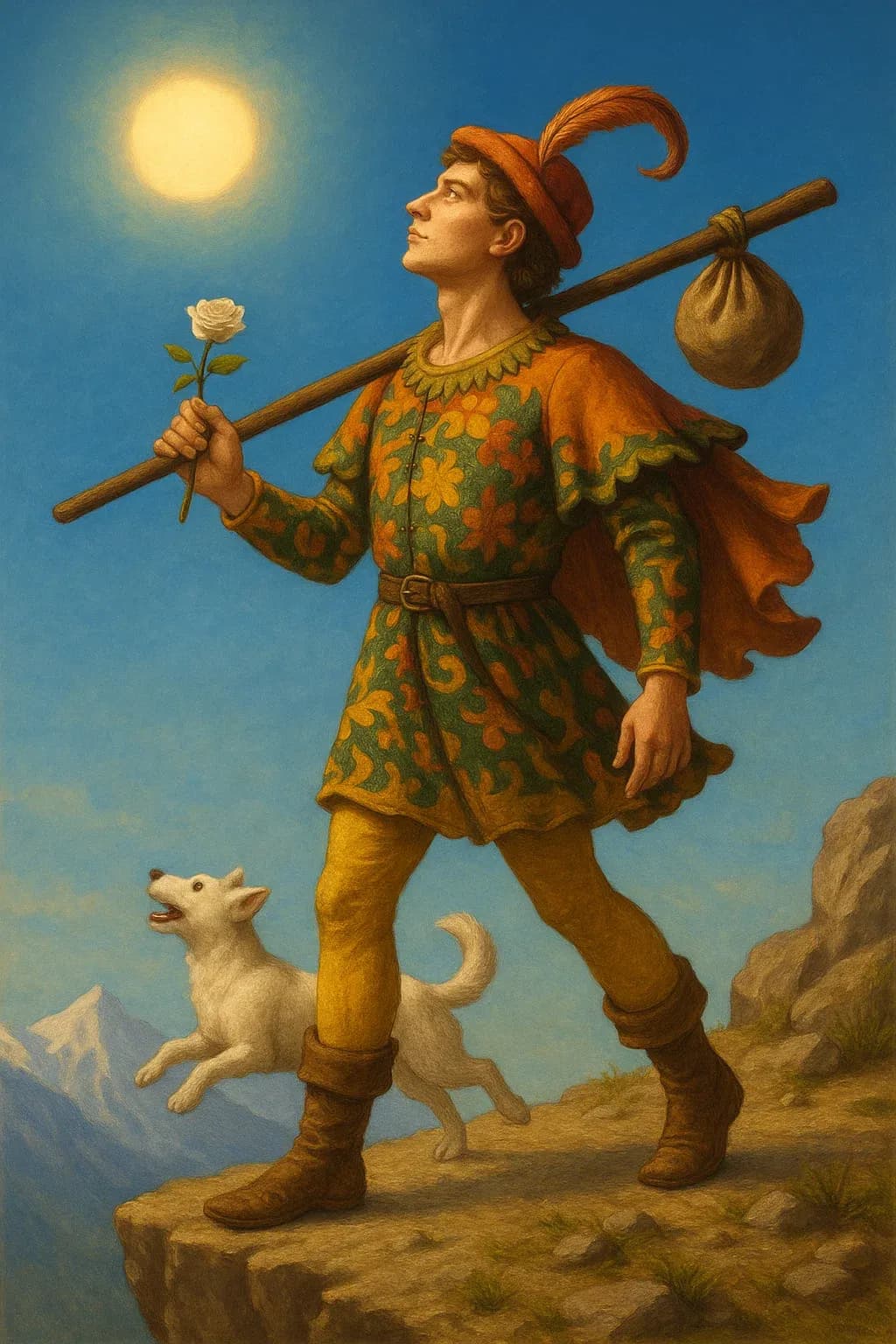 Tarot arcanaThe FoolThe Fool sets out from zero, carrying all of his potential in a knapsack. Twenty-two takes that boundless blueprint and carries it all the way into solid material form.What The Fool reveals →
What it means
The 22 in your Expression Number is the talent of the master builder: you hold the grand vision and the order of operations in the same mind at the same time. Where one person sees only the dream and another only the to-do list, you see the bridge between them — stage by stage, resource by resource. Your gift is not to invent the idea (that is the work of other numbers) but to make it stand on a foundation and hold. That is why people hand you what cannot be redone: the launch from zero, the construction, the reform that will touch hundreds of lives.
This talent works like an amplified 4 — which is why master number 22 is sometimes read as the 4 raised to its highest power. All the practicality, method, and love of a sound structure remain, but they get applied to a scale the 4 would back away from. Living out the Expression Number 22 is not a single heroic sprint or a brilliant improvisation; it is a long assembly, and the result is measured by whether the thing you built still works years later. You can plan across a horizon where most people lose interest — not because you are patient by temperament, but because you can see the whole structure and you know which brick goes after which.
This gift comes with one hard condition: the vision has to touch the ground. An idea that stays a magnificent plan is, for the 22, not an achievement but a debt. Your strength comes alive when the big goal acquires a deadline, a budget, named owners, and a first completed section; without that, the scale crushes you instead of moving you. So assign every large vision its nearest material result up front — something you can show in a month — and the sweep turns into a building site instead of a weight of things undone.
Twenty-two is a master number, the amplified vibration of the Four. To the reliability and order of the base Four it adds sweep: you are able to aim at something large and carry it into material form — a project, an organization, a body of work that will remain after you. That is the high potential of the double vibration: not just to build, but to build big and to build to last.
The price of that potential runs high too. Holding scale all the time means living under the weight of responsibility, and in exhaustion you sag back to the qualities of the Four: the pull to bury yourself in routine, to do work for work's sake, to hide behind order from the big task. That is not a failure but a signal to recover. Better to be honest here, without grand talk of being chosen: twenty-two doesn't make you special, it only raises both the bar and the load — and managing them is still on you, step by step.
Strengths
- Vision plus delivery. You hold the big goal and the plan for assembling it in one head, losing neither. Dreamers and doers are plentiful on their own; the person who fuses both is rare, and the largest tasks get handed to them.
- Scale without chaos. The bigger the project, the calmer you get: where others are buried by sheer volume, you break it into stages and resources. Complexity is your working environment, not an obstacle.
- The long distance. You can take on builds whose payoff arrives years out: an organization, infrastructure, a method. Your interest doesn't fade just because there's no monthly result to point to — you keep the whole structure in view.
- From idea to system. You don't just solve a problem; you build the machine that will solve it without you — a process, an institution, a working structure. You turn personal effort into something that outlasts your involvement.
- Built to bear load. You design in slack for stress and failure ahead of time, so what you make doesn't collapse at the first blow. People trust you with the things that can't be repaired on the fly.
- Responsibility as raw material. What others would refuse — the weight of a major project — is a working resource for you: you can carry a large zone of responsibility without offloading it and without buckling under it.
Challenges
- The endless blueprint. It looks like this: the project is thought through to the last detail, laid out for years ahead, and construction still hasn't started — there's always one more thing to clarify, approve, refine. The cause is that 22 sees the whole scale at once and is afraid to begin until everything is accounted for. Set a first material section with a near deadline and ship it without waiting for the whole vision to be ready: a poured foundation is more honest than any perfect drawing.
- The weight that won't divide. You haul the entire scale alone because you don't trust anyone else's work at that level of responsibility — and you hit burnout before you hit the result. The cause is the feeling that the cost of an error is too high to delegate. Break the project into sections with written acceptance criteria and hand off at least one whole section: check the result against the criteria instead of redoing it behind the person.
- Scale for the sake of scale. You take on bigger and bigger things, and the size of the goal starts to stand in for its meaning: the project is large, therefore it must be worthwhile. The cause is that 22 is drawn to scale as proof of itself. Before starting, test the vision with one question — what exactly will stand on the ground, and who needs it — and if you can't answer in one sentence, it's an ambition, not a task.
- Sagging down to the 4. When you're worn out, the big goal drops out of view and you shrink into endless tidying of small things: rearranging, rechecking, polishing what's already done instead of moving forward. The cause is that the 22 vibration demands a lot of fuel, and on the downslope only the base 4 is left. The moment you notice a week spent on details with no progress on the main thing, stop and write down the single next step toward the large goal — that's your signal it's time to recover, not to 'finish off the little stuff.'
- Built it — then dismissed it. Having delivered a major project, you don't mark it; you immediately see what could have been done better and reach for the next, even bigger one. The cause is that the 22's bar moves faster than the result. Write down, on paper, what exactly was built and how it works before reaching for anything new: skip that pause and what accumulates is fatigue, not achievement.
Is your number 22?
Enter your name in Latin letters (as in your passport) — we'll calculate and check.
In intimacy
In close relationships your builder's talent shows up as reliability you can see in deeds: you don't promise, you do — you fix, you provide, you construct the everyday life your partner can lean on. That is a rare and valuable contribution. The trouble is that a big project takes you whole, and the relationship slips easily into the 'later, once it's built' category, leaving your partner the leftover energy after the construction site closes for the day. What the partner feels then is not that you've cooled, but that they're standing in line behind the work — and that cuts deeper than an open fight.
- Give the relationship the status of a project, not a remainder: lock one shared evening a week into the calendar and hold it as firmly as a delivery deadline at work — what's in the plan, a 22 doesn't skip.
- Once a week, ask your partner what they're missing in daily life and take one item into your workload — your way of loving through deeds only lands when you build what they actually need, not what you decided to build.
- When you disappear into a big project, give your partner a specific date by which you'll be back to the normal rhythm — that certainty removes the feeling of being 'pushed aside indefinitely.'
Where it comes alive
You don't sell ideas or hours; you sell the built result — the ability to take a large vision and carry it to a working structure. Living out the Expression Number 22 looks like this: large-scale projects with a long horizon, real authority to direct resources and people, and a result you can touch or measure years later. When you choose a place, look not at the loudness of the title but at the shape of the task — whether you'll be allowed to carry a large undertaking to a material finish, or whether everything fragments into short assignments with no visible outcome. A 22 stands idle wherever there's nothing to build.
Where it gets hard: Freelancing on a stream of small one-off gigs — there's nowhere to deploy the scale, and assembling a living out of short tasks with no overarching structure quickly loses its value for a 22 · An executor role with no authority — seeing the whole structure and having no right to build it is more agonizing than a hard but genuinely your own construction site · Work on pure improvisation with no plan — rolling ad campaigns, one-off productions — where what's prized is the speed of the improv, not durability and a long horizon.
Which numbers it resonates with
Number 22 in their lives
Painter, engineer, anatomist: he carried dozens of vast designs all the way to blueprint and matter, holding scale and detail at once.
Poet, chemist, founder of a university: he built Russian science from the foundation up, fusing theory with practice.
A prime minister who rebuilt a nation's economy: a large goal driven through to systemic change at the cost of long, sustained strain.
He turned a singing career into an institution: the scale of the voice plus decades of hard discipline at the work.
She built her career on long bets rather than one-off roles: returning after pauses and reassembling big projects on her own terms.
She launched cosmetics and shapewear brands, scaling personal visibility into manufacturing companies.
Life path numbers are calculated from the full date of birth.
What to try today
- Take your single largest vision and assign its first material section a one-month deadline; on the appointed day, ship that section without waiting for the whole to be ready.
- Delegate one section of the project in full, with written acceptance criteria, and accept the result without redoing it if the criteria are met — even when you'd have done it differently.
- Today, test your current project with one question: what exactly will stand on the ground, and who needs it — if you can't answer in one sentence, write down what's missing.
- After finishing a major undertaking, and before launching the next, write down on paper what was built and how it works; any new vision that day gets recorded only, not started.
Number 22 in other roles
Short and to the point
The Life Path Number is calculated from your birth date and describes the road: the lessons, the turning points, the overall storyline of your life. The Expression Number — also called the Destiny Number — is calculated from your full name and answers a different question: what tool you've been given to do that work with. The difference shows in an example: a person with Life Path 22 and Destiny 3 would face the same lessons of scale but meet them through words and creativity. With Destiny 22 the tool is different — the ability to carry a large vision through to a material result, whatever road you happen to be walking.
Correct. The Expression Number is summed from every letter of your full name by its numeric value. If the total comes out to 22, you leave it as it is and do not reduce it to 4, because 22 is a master number with its own amplified vibration. In practice this means you read your result as a twenty-two, while keeping the 4 in mind as the base it falls back to when you're worn out. Check the calculation itself first: 11, 22, and 33 are the only sums that aren't reduced to a single digit.
No. Twenty-two is scale relative to your circumstances — not necessarily a stadium or a corporation. The talent shows up the same way in the large and the small: you carry to a working result something that's big for your level — a department you got running, a house you renovated with your own hands, a process you built from scratch. Check it another way: recall what you were trusted with that couldn't be redone, and where you joined a big vision to its step-by-step assembly. If there's no scale yet, more often it means you haven't yet given yourself a goal the size of your talent — not that the talent is missing.
That's exactly the master number sagging down to its base 4. The 22 vibration demands a lot of fuel, and when you're worn out the big goal drops out of sight and what's left is the 4 with its love of order in the details: you polish what's done and tidy things up instead of moving toward the main thing. The fix isn't fighting your meticulousness but resting and returning to the scale: if you've spent a week on small things with no progress on the large goal, write down the single next step toward it — and do exactly that one.
Don't look for a ready-made list of 'jobs for a 22' — test how the specific task is built. Ask yourself three things: can a large undertaking here be carried to a material finish, or does everything fragment into short assignments; do they give you real authority to direct resources and people, not just answer for the result; is success measured by whether what's built still works years later. Those conditions show up in construction, in IT, in management, and in the nonprofit sector alike. If two of the three are missing, the position may be impressive, but there'll be nothing to build in it.
All your numbers — together
Your six core numbers from your date and name, and how they work together — in a personal reading with a numerologist.
What else unlocks Taroruna

Online spreads — an answer to your pressing question in minutes.

Today's forecast for your sign — a quick check-in with the sky.

Your personal birth chart — character, talents and destiny.

Moon phases and favorable days for important matters.