Expression Number 1 for men and women: meaning, characteristics, compatibilityThe one who takes the first step
Your Expression Number is calculated from your full name, and the expression number 1 answers not "what do you want" but "what are you built to do better than most": start from nothing, make the call where others hold back, and own the direction you choose. Your instrument is authorship, not carrying out someone else's plan. The Expression Number is also called the Destiny Number, and a 1 here points to a destiny of going first.
The essentials
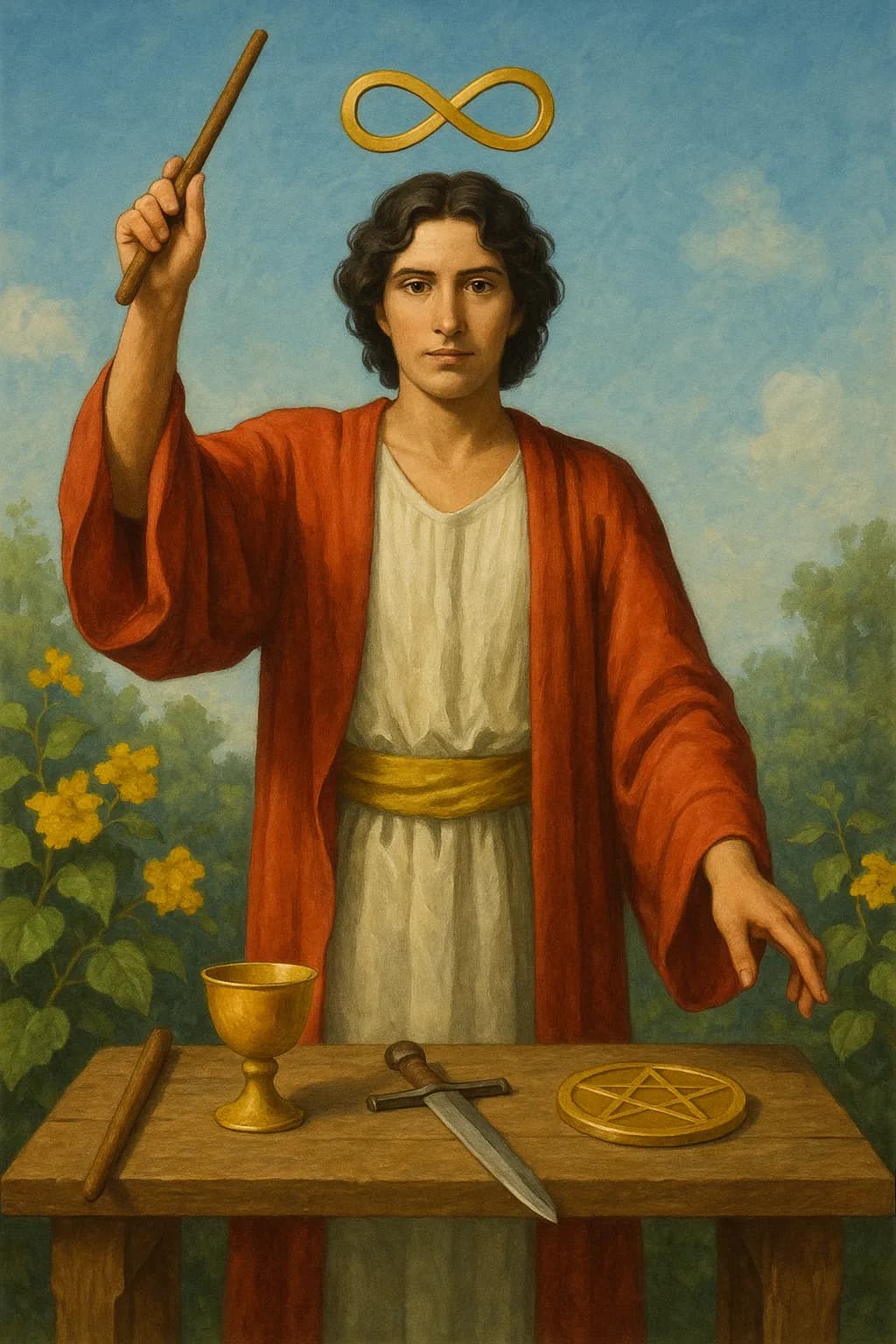 Tarot arcanaThe MagicianThe Magician stands alone at his table of tools and sets the work in motion by sheer will and focused intent — the same mechanics as the One: the impulse comes from within, not from anyone else's command.What The Magician reveals →
What it means
A 1 in the Expression Number is the founder's gift: you're built to turn "there's nothing here" into "this has begun." You commit to the first move faster than other people when the conditions are incomplete and nothing is guaranteed, and you pull one workable direction out of the fog. Where everyone else waits for things to get clearer, you make them clearer by acting. This isn't bravado for its own sake; it's a working tool. The call you make first sets the frame everyone else then operates inside.
This potential pays off through authorship, not execution. Your name comes alive where a thing has one person accountable, whose word settles it: your own venture, your own territory, your own line in a project that you carry from idea to result and sign with your name. As a cog in someone else's machine, the 1 doesn't so much suffer as idle. Your strength isn't measured by how well you carry out an order, but by how much you've started and seen through under your own responsibility.
This gift comes with one non-negotiable condition: what you start has to be carried to the point where it stands on its own, not dropped at the launch for the next launch. The 1's talent is to open, and it easily decays into a string of abandoned beginnings when each new thing pulls harder than yesterday's. The expression number 1 is measured not by how many things you launched, but by how many got on their feet and keep running without you. Put a finishing point on every venture — the moment after which it lives on its own — and only then take up the next one.
Strengths
- Starting from scratch. You're built to begin without a manual or complete data, where others need an example of "how it's normally done." A blank page isn't a fear for the 1; it's a working condition.
- Owning the decision. You make the call under uncertainty and don't pin the outcome on circumstances afterward. When the work has your name on it, the 1 closes the argument and carries whatever follows, instead of waiting for consensus to form.
- A signed result. What you do can't be quietly dissolved into "we, as a team": on a project it's visible where your hand passed and whose decision turned it. Where others hide behind shared responsibility, the 1 puts a name on the work and answers for it.
- A course out of the fog. Out of ten blurry options you pick one and call it the direction. The ability to narrow choice down to a decision is worth more than the ability to see every option.
- Going against the current. "That's not how it's done" doesn't stop you; it sharpens your focus — you test the rule for strength instead of obeying it out of habit. New niches and first versions are built on exactly this.
- Forward pull. You get a thing moving and pull the people around you onto your pace: with a 1 in the room, the warm-up is shorter and the start comes sooner. The drive to begin again doesn't run dry on you from one venture to the next.
Challenges
- A chain of abandoned starts. It looks like this: three things started, none finished, and you're already on fire about a fourth. The cause is that launching gives the 1 more energy than the grind of finishing, so the new always tempts more than yesterday's. Set a finish rule: until the current thing has a point after which it runs without you, the next one goes on a list, not into your workload.
- Everything on your own shoulders. You carry the whole load yourself, because handing off a piece means losing control of a result that's signed with your name. The root is that you don't trust someone else's pace or quality by default. Hand off the task with a written definition of "done" and accept the result if the criterion is met, even when you'd have done it differently.
- Pushing through instead of agreeing. You prove you're right by force, and people agree just to avoid the fight — then quietly sabotage it. The cause is that your direction seems obviously correct to you, so explaining feels like a waste. Before you insist, ask the second person what they'd do differently and build in one of their corrections: agreement in practice is worth more than agreement in words.
- No patience for someone else's pace. Anyone who thinks longer than you reads as a brake, and you finish their work for them — so they stop trying. The cause is that you take your own speed for the only workable one. Agree on a deadline and don't step in before it: check the result at a checkpoint, not the process along the way.
- Alone at the top. You get used to deciding solo and one day find there's no one to consult and no one to lean on. The cause is that asking for help feels to the 1 like admitting weakness. Get one person outside your chain of command whom you show a decision once a week before you announce it — not so they decide for you, but so you hear the objection in time.
Is your number 1?
Enter your name in Latin letters (as in your passport) — we'll calculate and check.
In intimacy
In close relationships the 1's talent is the same as in work: you take the first step, take the initiative, and don't wait for things to sort themselves out — with you, there's no guessing whether anything is moving. The 1's misstep in love is treating intimacy like one of your projects: you hand down a decision and expect it to land the way your direction lands at work. But home isn't your "territory under responsibility" — here the second voice isn't a subordinate but an equal, and a solo "I've decided" reads as "your voice isn't needed." And the slower pace you take for indifference is usually just your partner deciding at their own speed, not against you.
- Take one recurring shared decision — where to go on vacation, a big purchase — and run it like this: ask your partner's choice first, name yours only after; if you match, go ahead, if not, agree in advance whose word settles this topic.
- When you catch yourself saying "I've already decided," stop and turn it into a question: "here's my version, what do you think?" — and let your partner finish without cutting in with a correction.
- To the 1's partner: don't compete over who's in charge — claim a zone where the decisions are yours, and hold it; the 1 respects someone else's territory when it's marked out plainly, not won back through hints.
Where it comes alive
You're not selling obedience or hours — you're selling the readiness to start and to see it through under your own responsibility. Realizing the expression number 1 looks like this: a zone where you decide, a result with your signature on it, and the freedom to choose the path rather than be handed one. When picking a place, look past the title on the door and at how authority is wired: is there a zone where your word is final, and does this place count your started-and-finished work as the result, rather than tidy compliance with someone else's rulebook?
Where it gets hard: Line worker under a rigid rulebook — where a step out of line is punished, not rewarded: the 1's initiative isn't wanted here, and the 1 idles · Bureaucrat in a long chain of sign-offs — the decision gets diluted across departments, and the authorship the 1 runs on is left with nothing · A long supporting role with no zone of your own — servicing someone else's finished process with no right to change it means, for the 1, working in neutral.
Which numbers it resonates with
Number 1 in their lives
Built a company from nothing twice and imposed his own vision on the market — driven by 'I already know how this should be done.'
Pulled his studio out of bankruptcy and was the first to bet on a feature-length animated film when everyone told him not to.
Stepped to the head of the movement and walked out front when it was dangerous — leadership that didn't wait on anyone else's pace.
Wrote, directed, starred in and produced his own films, handing control to no one.
Broke with the literary establishment and went his own way — from novels to a creed of his own, against the current.
Fought her way up alone and forced her own image on the industry rather than bending to its format.
Life path numbers are calculated from the full date of birth.
What to try today
- Today, carry one of your started projects to the finish and put a point on it after which it runs without you; new ideas only get written down, not launched into work.
- On the next shared decision, ask the other person's choice first and hear them out fully, and only then name yours — check by evening that you didn't cut in.
- Delegate one task with a written definition of done and don't step in before the checkpoint; accept the result if the criterion is met.
- Before you insist on your way, ask one person who disagrees what they'd do differently, and build one of their corrections into the decision.
- Once a week, show a not-yet-announced decision to someone outside your chain of command and write down their objection — that's your list of weak points at the start.
Number 1 in other roles
Short and to the point
The Life Path Number is calculated from your birth date — it's the road: the lessons, the turns, the overall story. The Expression Number, also called the Destiny Number, is calculated from your full name and answers a different question — what you're built to work with. Compare them: a person with Life Path 1 and Destiny 2 would walk a road of independence but win through alliances and mediation. With Destiny 1 the instrument is different — to start and to answer for what you started, whatever road you're on.
No. The Expression Number shows what you win on, not where you're barred from. On a team the 1 is strong wherever it has its own zone under full responsibility: a direction you carry whole, not a line item in someone else's plan. Check where the fatigue comes from: if what wears you out isn't the volume but having to wait for someone else's decision and sign off on every step — that's the number's hint. Ask for a zone where you decide, and after two weeks compare where the work felt lighter.
Yes, it's its working trap. The talent for opening has no built-in brake: launching gives the 1 more energy than the grind of finishing, so the new always tempts more than yesterday's. But value is measured not by the number of starts but by the number of things that got on their feet. The cure isn't banning ideas — it's a finish rule: until the current thing has a point after which it runs without you, a new one goes on a list, not into your workload.
The classical school calculates the Expression Number from the full name at birth: it describes your base set of talents, and it stays with you. A married name or a pseudonym is read as an extra layer — the vibration you're using now. Calculate the birth name first: if there's a 1 there, the founder's core is in place. Then compare with your current name — the difference shows what you've "put on" over it: say, the diplomacy of a 2 or the practicality of a 4.
Don't hunt for a ready-made list of "jobs for a 1" — test the wiring of the specific place against three questions. One: is there a zone where you make the decisions rather than clear them upward. Two: does this place pay for what's started and finished, or for following instructions. Three: is your individual contribution visible in the end result. These conditions show up in business, in science, and in craft alike. If at least two of the three are missing, the place may be prestigious, but your main instrument won't be needed there.
All your numbers — together
Your six core numbers from your date and name, and how they work together — in a personal reading with a numerologist.
What else unlocks Taroruna

Online spreads — an answer to your pressing question in minutes.

Today's forecast for your sign — a quick check-in with the sky.

Your personal birth chart — character, talents and destiny.

Moon phases and favorable days for important matters.