Birthday Number 22 for men and women: meaning, characteristics, compatibilityThe one who carries the big thing all the way to finished
If you were born on the 22nd, your everyday tool is assembly: you take something big and shapeless and turn it into a plan with stages, deadlines, and a result you can touch. Where others stall between "great idea" and "but how do we actually do this," Birthday Number 22 builds the bridge across.
The essentials
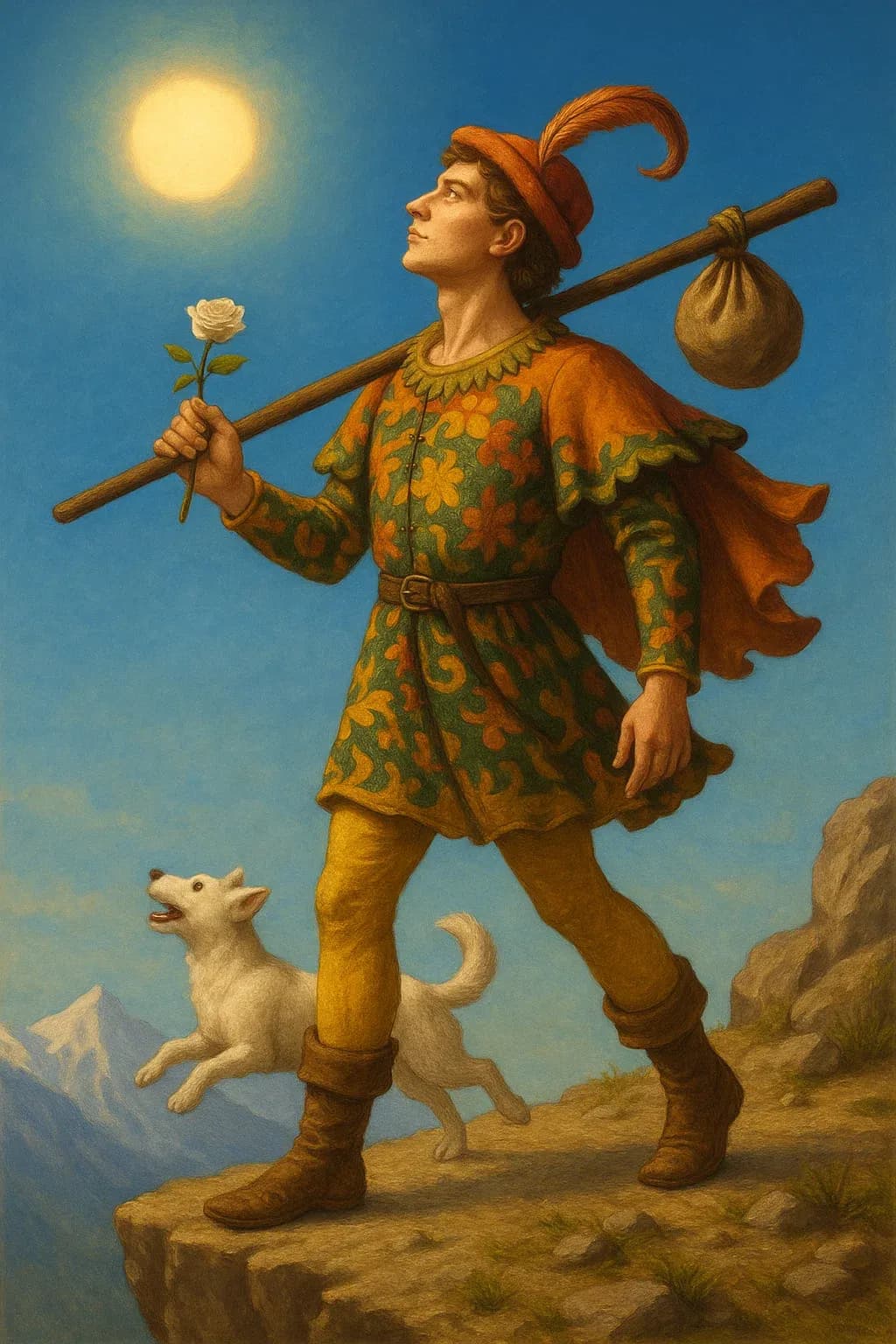 Tarot arcanaThe FoolThe Fool sets out from zero, carrying all of his potential in a knapsack. Twenty-two takes that boundless blueprint and carries it all the way into solid material form.What The Fool reveals →
What it means
The Birthday Number is the most hands-on layer of your numerology profile: not your life's road, not your whole character, but one concrete skill that shows up in an ordinary day. People say to you "we should organize this move," "let's gut and renovate," "it'd be great to launch this" — and while everyone else is still talking it over, you're already counting: what comes after what, what it costs, who does which part, by what date it's done. You hold the whole picture and the first practical step in your head at once. That is the tool: turning a large idea into a structured result that actually gets finished.
The tool has two halves, and its power is that they work as one. The first is appetite for scale: a heavy workload doesn't scare you — a small task bores you, while a six-month project with a dozen people fits naturally in your hands. The second is grounding: you translate the idea straight into a budget, a schedule, and a list of what has to be sourced. An idea without a budget isn't a plan to you, it's a conversation. That is why big things in your hands reach a finished state instead of staying a beautiful presentation.
The difference between a 22 the tool serves and a 22 it grinds down comes down to the size of what you take on. When you carry work worthy of the tool all the way through, you're in your element. When you're tired and overloaded, you collapse into a plain doer: you haul everything yourself because "it's faster to do it than explain it," and you lose sight of what it was all for. The tell-tale sign — you're buried in the process but can no longer name the goal. The fix is to hand part of the work to others and check, every week, what exactly you're building toward.
Twenty-two is a master number, the amplified vibration of the Four. To the reliability and order of the base Four it adds sweep: you are able to aim at something large and carry it into material form — a project, an organization, a body of work that will remain after you. That is the high potential of the double vibration: not just to build, but to build big and to build to last.
The price of that potential runs high too. Holding scale all the time means living under the weight of responsibility, and in exhaustion you sag back to the qualities of the Four: the pull to bury yourself in routine, to do work for work's sake, to hide behind order from the big task. That is not a failure but a signal to recover. Better to be honest here, without grand talk of being chosen: twenty-two doesn't make you special, it only raises both the bar and the load — and managing them is still on you, step by step.
Strengths
- Breaks the big thing into steps. A goal like "renovate the apartment" or "run a conference" you turn, in half an hour, into a list of stages with an order and deadlines. What scares others by its sheer size becomes, in your hands, a plain sequence of actions you can start ticking off.
- Counts in concrete terms. You translate an idea straight into a budget, deadlines, and a list of resources: how much money, who does the work, what has to be bought. The idea gets the "what do we build this out of" test before everyone gets carried away by it.
- Carries it to done. You don't drop things at ninety percent: for you a project is closed when it can actually be used, not when it's "basically finished." You're the one to hand the part that genuinely has to work the day it ships.
- Holds scale without panic. A dozen tasks and people, a long timeline, many moving parts — where others lose the thread, you see the overall scheme and the one knot that has to be untied first.
- Builds what outlasts the builder. You build not for one use but with a margin: a process that runs without you, a document the next person can follow. Your result doesn't fall apart the moment you step away from it.
- Connects the dreamers and the doers. On a team you're the translator between "let's do something epic" and "we have two people and a week." You take someone's big idea and name the one piece of it that can realistically be built first.
Challenges
- Takes on more than is liftable. You say yes to a project three times bigger than is reasonable, because scale pulls at you and "I'll manage" sounds convincing. A month later you're alone carrying what was meant for five. Before you agree, count honestly: how many hours a week will this eat, and at whose expense. If the number doesn't fit your calendar, split the project or decline — don't play the hero.
- Does it himself instead of handing it off. Explaining and supervising feels slower than just doing it, so you pull other people's tasks back onto your plate. That turns you from the builder into the hauler, and you burn out. The rule: at the start of a project, write down who owns what, and keep only the knots that won't come together without you. Hand off the rest and don't grab it back, even when it comes out imperfect.
- Drowns in the process and loses the goal. When you're tired you sink so deep into details and schedules that you forget what it was all started for, and what's left is work for work's sake. This is the drop to your base Four. Once a week, write in one line what finished result you're after, and check whether this week's tasks bring it closer; cross out the ones that don't.
- Delays the start until the plan is perfect. You won't begin until the scheme is worked out to the last detail, and meanwhile the moment slips away. Fear of launching and not pulling it off keeps you in place. Give the plan a hard deadline — say, three days — and when it's up, launch the first stage with what you have; build out the rest as you go.
- Measures himself by the peaks not yet climbed. You've built a lot, but you stare at what you haven't built yet and count it as not enough. A high ceiling turns into a standing sense that you're falling short. At the end of the week, write down three concrete things you carried to done, and judge yourself by those, not by the distance to some imagined bar.
Is your number 22?
Enter your birth date — we'll calculate and check in a second.
In intimacy
Your builder's tool comes home with you, and at home it reads as reliability: a shared vacation, a move, a renovation, a big purchase — in your hands these reach a result instead of hanging in endless discussion. Your partner knows that if you've taken something on, it gets done. The flip side is that you sometimes run the relationship like a project too: with a plan, stages, and an expected outcome. But closeness isn't delivered on a deadline and doesn't add up from completed checklist items; next to a person you sometimes just need to be there, with no budget and no schedule.
When you vanish headfirst into a big project, at home it reads as "work matters more than us," though for you it was never a choice against your partner. Say out loud what's happening and when it eases up — "this build runs to the end of the month, then I'm back" — and the time you've fixed for the two of you will stop getting pushed aside by the next stage.
- Once a week, spend time with your partner that has no tasks, no plans, and no "while we're at it, let's sort out" — just talk and being present; agree on a specific day and don't move it for a project.
- When your partner shares something they're going through, don't hand them a fix-it plan straight away: ask whether they want it worked through or whether it's enough that you're there and listening.
- Big family undertakings — a renovation, a vacation, a major purchase — split with your partner by zones of responsibility rather than taking the whole thing on "so it's done right"; their share matters more than flawless execution.
Where it comes alive
The tool pays off where the work is to carry something big from idea to delivered result: to launch, to build, to organize something complex with many parts and bring it to where people actually use it. Choose roles with scale and a visible, tangible outcome, where you're given both authority and people, not just responsibility. Small, repetitive tasks with no horizon you outgrow fast, and pure idea-spinning with no path into reality empties you out.
If the job isn't built around large projects, the tool still applies inside it: take on what needs to be built and made to run — a procedure that actually works, a department move, the launch of a new process. Ask for resources and a team to match the scope you take on: a 22 alone hauls what was meant for a group and pays for it in burnout. One large project carried to done says more about you than a dozen that were merely started.
Where it gets hard: Operator on a stream of identical tasks — no scale, no horizon; the tool sits idle and goes dull from the monotony · Freelancer on small one-off jobs — every project ends before the scope can unfold, and nothing is left that builds onward · Idea generator with no path to delivery — to invent and never carry it into the material is agony for a 22, who is built for the result, not the brainstorm · Narrow specialist with no say over the plan — watching something big get assembled wrong and being unable to step in wears you down more than any workload.
Which numbers it resonates with
Number 22 in their lives
Painter, engineer, anatomist: he carried dozens of vast designs all the way to blueprint and matter, holding scale and detail at once.
Poet, chemist, founder of a university: he built Russian science from the foundation up, fusing theory with practice.
A prime minister who rebuilt a nation's economy: a large goal driven through to systemic change at the cost of long, sustained strain.
He turned a singing career into an institution: the scale of the voice plus decades of hard discipline at the work.
She built her career on long bets rather than one-off roles: returning after pauses and reassembling big projects on her own terms.
She launched cosmetics and shapewear brands, scaling personal visibility into manufacturing companies.
Life path numbers are calculated from the full date of birth.
What to try today
- Pick one big thing today that you've been holding as just an idea, and write it out on paper as stages with deadlines — move it from conversation into a plan.
- On your current project, find one task you do yourself out of habit, and today hand it to a specific person with a clear result and deadline.
- Before you agree to a new project today, count how many hours a week it will eat and check it against your calendar; if it doesn't add up, decline or cut the scope out loud.
- Write in one line what finished result your main project is for, and cross out of this week's plan one task that doesn't bring it closer.
- In the evening, name three things you carried to done today, and judge the day by those, not by how much is still undone.
Number 22 in other roles
Short and to the point
It depends on whether the calculator recognizes master numbers. Twenty-two is a master number, and it isn't reduced to 2+2=4 the way ordinary two-digit days are. If the calculation leaves it as 22, you have the tool described here at full strength. If the program automatically collapses it to 4, it simply doesn't single out master numbers. In effect you carry both vibrations: the large-scale assembly of the 22 and the practical reliability of the Four that underlies it. The Four is what the 22 drops to when you're worn out.
The Life Path Number is calculated from your whole date of birth and describes the long road: the lessons and turns that unfold over years. Birthday Number 22 is a narrow, applied skill you can see right now, with no distance involved: you take something big and carry it into the material. Having different numbers is perfectly normal. In that case the 22's builder's tool works inside a different main task: with a Life Path 3, say, you're a person of ideas and connection who also has the rare ability to assemble what's imagined into a finished result.
The tool doesn't need a title with the word "director" in it. It kicks in when you plan a family move, run a renovation from budget to move-in day, organize a big celebration, or build out a household budget a year ahead. In any job, take the parts that need not just doing but building and getting to run: a new process, a procedure, a department move. Where others do things the way they always have, your ability to assemble something big into a working whole is a real contribution, even if your job title has no "project" in it.
It is, but pointed at the wrong size of task. Taking on big things is your strength; the glitch is in the aim: the tool is built for large projects, and you fire it up on everyday trifles too, turning a quick errand into a construction site. The working rule: before you start, honestly name the size of the task. If it's a ten-minute job, do it in ten minutes and don't unfold it. Save the full sweep for what genuinely calls for it; then what got you called an overcomplicater becomes valued as the ability to lift what others can't.
It's there from birth, but it works like a skill: it strengthens with practice and weakens without it. The training is plain: before you take on any big task, break it down in writing into stages with deadlines and resources; learn to hand part of the work to others rather than hauling it all yourself; carry what you start to a state where it can actually be used, and only then take on something new. After a couple of months, compare how many large undertakings you've carried to done versus dropped in the middle — the difference will show how much the tool has grown.
All your numbers — together
Your six core numbers from your date and name, and how they work together — in a personal reading with a numerologist.
What else unlocks Taroruna

Online spreads — an answer to your pressing question in minutes.

Today's forecast for your sign — a quick check-in with the sky.

Your personal birth chart — character, talents and destiny.

Moon phases and favorable days for important matters.