Life Path Number 22 for men and women: meaning, characteristics, compatibilityThe builder's road: scale is the assignment, not the prize
Life Path Number 22 is the road of the master builder. From early on, life keeps handing you a job bigger than seems doable and quietly closes off the option of hiding in something small. The core lesson of this path is to translate a large vision into a finished thing brick by brick, without burning out under its size and without abandoning it halfway. As a master number, 22 makes scale itself the assignment.
The essentials
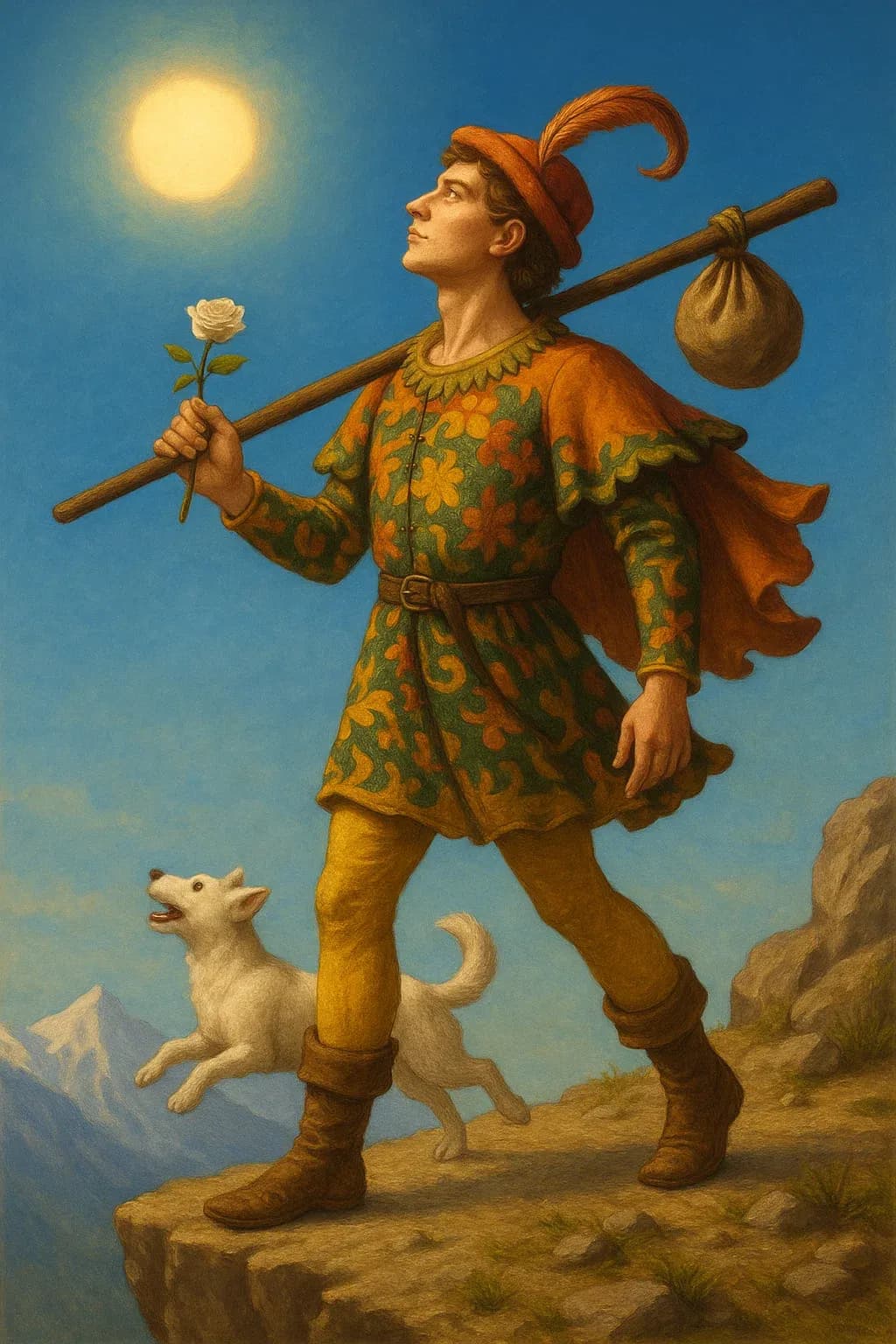 Tarot arcanaThe FoolThe Fool sets out from zero, carrying all of his potential in a knapsack. Twenty-two takes that boundless blueprint and carries it all the way into solid material form.What The Fool reveals →
What it means
The main storyline of this road shows up in childhood: again and again you're handed a job bigger than your peers' — organize it, build it, see through what others won't touch. Scale arrives not as a reward but as a condition. Life Path Number 22 is wired so that small-format work isn't left to you for long, and the easy exit a 3 reaches for — dreamed it up, got excited, dropped it — is closed here. The vision can't just be conceived; it has to be laid into matter until there's a result you can put your hand on, or it presses on you from the inside, unbuilt.
The path has recognizable stages. The first third is plain, almost understated: you learn the craft, the system, the numbers, you cut your teeth on other people's projects, and it feels like nothing 'great' is happening. That's not a detour — it's the foundation. The 22 road hands you the 4's practice first and only later the scale. The middle is the turn: a vision shows up that won't let go, and the weight comes with it — the sense that you have no right to fall short, and the fear that all that potential will stay a rough draft.
The third recurring storyline is the cost of scale. The larger the thing you're building, the longer there's no visible return, and the road keeps testing you on the stretches where the result isn't there yet but everything still has to go in. Here the lesson isn't a heroic sprint but a pace that survives years: big things are built slowly, and a master who burns out won't finish his. The mature stretch is the handover — what you raised single-handed stops growing on this road until there are other hands beside you that you've trusted with a part of it.
Twenty-two is a master number, the amplified vibration of the Four. To the reliability and order of the base Four it adds sweep: you are able to aim at something large and carry it into material form — a project, an organization, a body of work that will remain after you. That is the high potential of the double vibration: not just to build, but to build big and to build to last.
The price of that potential runs high too. Holding scale all the time means living under the weight of responsibility, and in exhaustion you sag back to the qualities of the Four: the pull to bury yourself in routine, to do work for work's sake, to hide behind order from the big task. That is not a failure but a signal to recover. Better to be honest here, without grand talk of being chosen: twenty-two doesn't make you special, it only raises both the bar and the load — and managing them is still on you, step by step.
Strengths
- Scale doesn't scare you. A job whose size makes others step back is ordinary work for you — since childhood you were handed things bigger than your peers'. You see the whole building where others see separate bricks, and you don't freeze in front of the volume.
- The vision reaches matter. An idea rarely stays an idea with you: the road trained you to carry it through to something you can touch. You walk the whole stretch between 'thought of it' and 'done,' instead of dropping out at the interesting part.
- The foundation was laid early. The first stretch of the path gave you a craft and a system, not just a dream. So you come to the big vision with hands that already know how, not with inspiration alone.
- Stamina for the long build. Projects with no quick payoff don't break you: the path kept putting you where the result is years away. You hold the pace where others drop off at the first plateau.
- Responsibility as footing. You can be leaned on for something big: what you take on gets finished. People read that and trust you with what they won't trust to others — and the scale finds you on its own.
- Doer and dreamer in one. You pair the sweep of a vision with the arithmetic of a budget — a rare combination. An idea grows deadlines and resources the moment you have it, so the big thing never just hangs in the air.
Challenges
- The weight of responsibility flattens you. You carry the whole vision yourself, delegating doesn't take, by evening there's nothing left, and dropping what you took on feels like a betrayal of the cause. This happens because you habitually treat this path's scale as your load alone. Write out the project's tasks and hand at least three of them to specific people with a date — and don't redo their work afterward.
- Fear of leaving the potential unused. The big vision gets postponed for years — 'not the right time yet,' 'I need to prepare better' — while a sense of something missed presses from inside. The root is in how the path is built: scale was given as a condition, and unrealized it feels like an unpaid debt. Cut one piece off the big vision that can be finished in a month and start there — a build moves from a brick, not from a finished plan.
- Burnout under your own bar. You work at the limit for months, treat rest as a luxury, your body signals, and you push through. This happens because the cost of scale on this path is high and you try to pay it in one sprint. Build a pace into the project's schedule that survives a year: a fixed day off and an hour more sleep aren't weakness — they're the condition for the big thing getting finished at all.
- Dropping down to the level of 4. In exhaustion the scale shrinks to routine: you drown in operations, polish details, and lose sight of the building itself. This is the master number sagging to its base — when the energy runs out the practice stays but the sweep is gone. Once a week step away from tasks and check against the whole — why is the thing being built being built; without that check you'll raise a perfectly straight wall in the wrong place.
- Discounting what's done. You don't notice what you've finished — you immediately see the next, even bigger peak, and what you covered seems not to count. That's how the path's bar works: the scale is always ahead, and the done fades against it. After each finished stage, name out loud exactly what was built, and take a pause before the next — otherwise the chase after potential never ends.
Is your number 22?
Enter your birth date — we'll calculate and check in a second.
In intimacy
Relationships on this path get tested by the scale of the work: you're used to a big vision eating your time and energy, and the partner often ends up in line behind the build. The plot repeats from relationship to relationship — you go into the project head-first, sincerely believing you'll 'make it up later,' while the person closest to you spends months looking at your back at the desk. The tension builds not from fights but from that silent 'the work matters more right now.'
The lesson of this stretch is to let your partner into the vision, not just into its fallout. A 22 habitually drags the load alone and shares only the finished result; the pair travels the road more calmly when the person close to you sees the build from the inside, understands what you're disappearing into, and your 'later' has an actual date on it.
- Once a week, block an evening with no project in your calendar and don't move it for a deadline — a partner values predictability over rare grand gestures.
- Bring the person close to you into one of your visions as a participant: give them a clear part of the work, not just an account of how tired you are.
- To the partner of a 22: don't call them to 'finally rest' in the thick of the build — ask which piece you can take off them so the evening frees up; help by doing works better than persuading.
Where it comes alive
Your career line on this path isn't titles — it's the things you've raised: you're drawn to where a vision grows into something large and tangible — a system, an organization, a product, a building. The plot is recognizable: you come in as a doer, learn the work down to its foundations, and at some point the scale of the task outgrows the role — doing a part gets cramped when you can see the whole. That's a turn in the road, not ambition: Life Path Number 22 leads you to projects that can't be done halfway.
The fork 'execute or build your own' will come up more than once, and the path's lessons side with the big project under your own responsibility. But there's a condition: without a team and a sustainable pace, scale turns into a burden. If each next rung is just more and more tasks on your own hands with no right to delegate, that's movement into burnout, not up the road.
Where it gets hard: narrow operator of a single task with no line of sight to the whole — the scale finds no use and piles up as irritation · freelancer on a stream of small one-off jobs — there's no big vision worth giving everything for · the role of 'eternal second' with no right to decide — you see the whole building, but they only let you build a corner · a position with frequent project changes before completion — on this path the unfinished presses harder than it does on others.
Which numbers it resonates with
Number 22 in their lives
Painter, engineer, anatomist: he carried dozens of vast designs all the way to blueprint and matter, holding scale and detail at once.
Poet, chemist, founder of a university: he built Russian science from the foundation up, fusing theory with practice.
A prime minister who rebuilt a nation's economy: a large goal driven through to systemic change at the cost of long, sustained strain.
He turned a singing career into an institution: the scale of the voice plus decades of hard discipline at the work.
She built her career on long bets rather than one-off roles: returning after pauses and reassembling big projects on her own terms.
She launched cosmetics and shapewear brands, scaling personal visibility into manufacturing companies.
Life path numbers are calculated from the full date of birth.
What to try today
- Pick a big vision you keep postponing, cut a one-month piece off it, and write the date of the first step into your calendar.
- Today, delegate one task from the current project to a specific person and don't take it back.
- Put one fixed day off per week into the project schedule and don't move it for a deadline.
- Once a week, write out what the current project is being built for, and cross off the tasks that don't serve that goal.
- After a finished stage, name out loud or in writing exactly what was built, and take a pause before the next one.
Number 22 in other roles
Short and to the point
Add up all the digits of your full birth date. If at an intermediate step you get 22 — for example, the day, month, and year sum to 22 — you don't reduce it down to 4: 22 is a master number and is left as is. The same goes for 11 and 33. The full date is used — day, month, and year — so your Life Path Number doesn't change over your lifetime. If 22 never appears at an intermediate step, your path is described by a different number.
No. Scale on this path is an assignment, not a status you were issued, and it arrives in stages: the first third of the road is almost always quiet — you learn the craft on ordinary work. 'Great' here isn't about fame but about what's carried into matter: a department built up, a family raised from nothing, a system set running at work — that's the master build. If there's no big vision yet, the path will toss one your way; the holdup is more often that the preparation never seems to finish.
The number and the bar. A 4 builds reliably and at a manageable scale — that's its norm. 22 is the amplified vibration of the 4: the same tool of work and system, but the vision is set deliberately larger than seems within reach, and that's the whole lesson. An important detail: in exhaustion, 22 sags down to 4 — it loses the sweep and drowns in routine. So Life Path Number 22 isn't 'better,' it's costlier: high potential demands a pace that can sustain it.
That's how the road is built, not bad luck. Life Path Number 22 keeps putting you where someone is needed who can carry the large thing and see it through — and people read your reliability and trust you with what they won't trust to others. The lesson isn't to refuse the scale but to stop carrying it alone: responsibility for a big undertaking and the habit of doing everything with your own hands are different things, and on this path you have to unlearn the second.
That fear is the companion of your particular path: when scale is given as a condition, an unrealized vision feels like an unpaid debt, and it presses. Only one thing works — stop waiting for the finished plan and start from a brick. Cut a piece off the big goal that you'll finish in a month, and do it; the large thing on this road assembles from small parts carried to completion, it isn't born whole. Potential is realized in what's built, not in what's mulled over.
All your numbers — together
Your six core numbers from your date and name, and how they work together — in a personal reading with a numerologist.
What else unlocks Taroruna

Online spreads — an answer to your pressing question in minutes.

Today's forecast for your sign — a quick check-in with the sky.

Your personal birth chart — character, talents and destiny.

Moon phases and favorable days for important matters.