Maturity Number 22 for men and women: meaning, characteristics, compatibilityAfter forty, the demand arrives: build the one thing you were made for
Your Maturity Number is the sum of your Life Path and your Destiny Number, and it points not at your character but at the trajectory of your second half of life. The maturity number 22 means this: after thirty-five or forty, what arrives is not rest but a demand to build the single thing all your earlier experience was quietly accumulating toward. Everything you have gathered finally consolidates into one project you can carry through to something solid and real.
The essentials
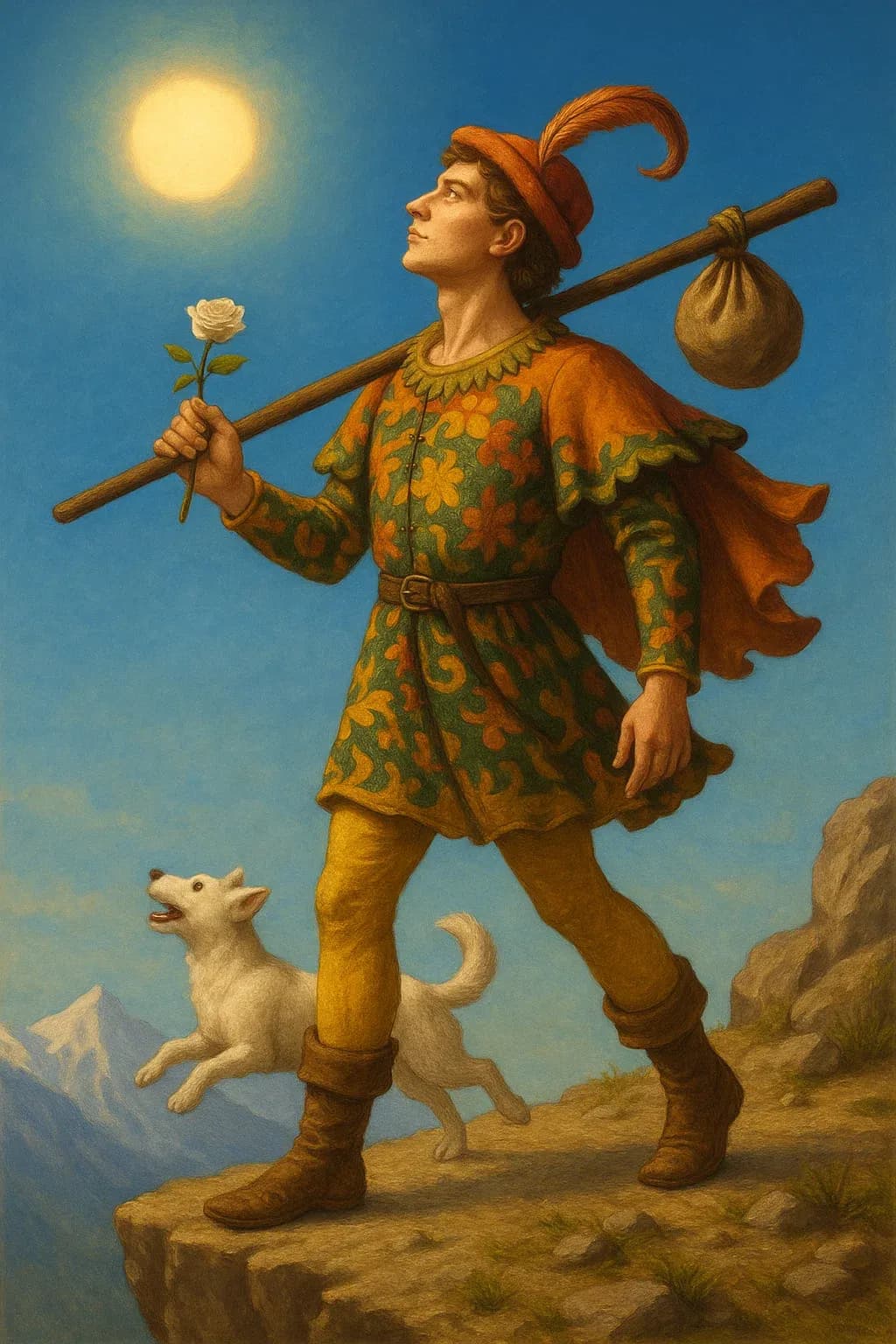 Tarot arcanaThe FoolThe Fool sets out from zero, carrying all of his potential in a knapsack. Twenty-two takes that boundless blueprint and carries it all the way into solid material form.What The Fool reveals →
What it means
The maturity number 22 unfolds like this: by thirty-five or forty, the scattered skills, contacts, and reputation you collected across the first half stop reading as separate threads and start asking to fuse into a single project. Where scale used to be a someday dream, there is now actual resource behind it, and the inner question shifts from "can I handle it?" to "why haven't I started yet?" This is not a beginner's ambition. It is the demand of maturity: to realize a potential that will otherwise sit on you as the weight of the undone.
In practice the turn looks like a move toward bigger things. The small tasks that filled your days for years start to grate; you want to hand them off and free your hands for the main work. A need appears to build for the long haul, a company, a school, a system, a structure, something that will outlast you and run without daily supervision. Your tolerance for "projects that just keep you busy" drops: 22 in the second half measures a piece of work by whether something durable remains after it, not by whether the hours were filled.
The main risk of this turn is letting its own scale crush you. As a master number, 22 is the amplified vibration of the four, and under exhaustion it sinks back into the four: instead of building the big thing, you disappear into routine, into the endless finishing of details, into work for its own sake, and you call it responsibility. A simple test separates the mature builder from the burned-out one: is the construction advancing toward a visible result, or are your forces going into propping up what already stands? If it is the second, the turn has fallen into a trap, and the cure is not a fresh push but narrowing the front to one project you can actually finish.
Twenty-two is a master number, the amplified vibration of the Four. To the reliability and order of the base Four it adds sweep: you are able to aim at something large and carry it into material form — a project, an organization, a body of work that will remain after you. That is the high potential of the double vibration: not just to build, but to build big and to build to last.
The price of that potential runs high too. Holding scale all the time means living under the weight of responsibility, and in exhaustion you sag back to the qualities of the Four: the pull to bury yourself in routine, to do work for work's sake, to hide behind order from the big task. That is not a failure but a signal to recover. Better to be honest here, without grand talk of being chosen: twenty-two doesn't make you special, it only raises both the bar and the load — and managing them is still on you, step by step.
Strengths
- Experience consolidates into a project. By maturity the disconnected skills and contacts of your first half stop being a random collection: you see how to assemble them into one large-scale project. What stays a string of episodes for your peers becomes a foundation for you.
- Resource behind the scale. The vision that was a dream without support in your youth is now backed by a name, experience, and connections. You judge a big idea not by how bold it is but by what you can actually build it from, and that is what lets you carry it through to a material result.
- Patience for the long build. After forty you can run an undertaking whose payoff comes years out without losing pace at the midpoint. Where others burn out over the distance, you hold the line, because you clock progress by the stage cleared rather than by today's mood.
- Readiness to delegate. By maturity the small tasks start to get in the way, and you learn to hand them off, freeing your hands for the main thing. That turns you from a doer into the one who builds and directs instead of drowning in detail.
- The work matters more than recognition. External proof of success weighs less by maturity than a durable result. You invest calmly in what won't be applauded today, and you don't trade the big goal for quick approval.
- A base for a legacy. You are drawn to build what will outlast its author and run without daily oversight, a system, a school, a structure. That is ready ground for the role of founder, and of the one whose work others carry on.
Challenges
- The scale presses down as a burden. After forty the size of what you've imagined starts to weigh on you rather than inspire you: it feels as if a single mistake would bring the whole thing down. So the start keeps getting postponed; better to keep preparing than to risk it and fail. Break the big thing into stages with deadlines and judge yourself by the stage you've cleared, not by whether the whole structure is standing.
- Sinking into routine. Running on empty, 22 loses its scale and collapses into the four: your days fill with finishing details and tidying up while the main build stalls. The cause is not laziness but exhaustion you've disguised as busyness. Once a week, check whether the main project has moved at all in those seven days; if it hasn't, cut the front and recover your strength rather than piling on more tasks.
- Fear of not realizing your potential. By maturity an anxiety builds that what was given to you will stay undone, and it pushes you to grab several big undertakings at once. The result is that none reaches the end, and the sense of something missed only grows. Pick one project where you'll leave a durable mark and shelve the rest until it stands on its own feet.
- Everything on your own shoulders. You're used to it being safer to do it yourself, and by maturity you carry the whole project, trusting the key parts to no one. That's a ceiling: one person doesn't build something big alone. Name three tasks someone else could do and hand them over this week with the right to make mistakes, not under your supervision.
- The work crowds out the people close to you. The big build eats your time, and the people closest to you end up on the leftover scraps of attention while you explain it as a duty to the work. To them it reads as "the job matters more." Set a regular shared time and protect it as firmly as a work deadline, otherwise you'll have a foundation but no one to live in it with you.
Is your number 22?
Enter your birth date and name in Latin letters — we'll calculate and check.
In intimacy
In a partnership that settled long ago, the turn of 22 shows up in how the work starts taking up more and more room: evenings go to the project, conversations narrow down to it, and "let's get away somewhere" is met with "once I finish this stage." The maturity turn here is a renegotiation: you need the build not to be treated as a rival, and your partner needs solid proof that they are not the remainder left over after work, but part of what the whole thing is being built for.
If you are on your own in these years, the sturdier bonds form with someone who understands the cost of a big undertaking and doesn't demand that you choose between them and the vision. A late partnership for the maturity number 22 holds together not on romance but on a shared footing: beside this person you don't have to justify the scale or hide the fatigue, and then the work and the relationship stop pulling in opposite directions.
- For 22: set one evening a week with no project and no talk about it. Put it in the calendar the way you'd put in a work meeting, and don't move it for a deadline. It is a concrete signal that the person you love is not on the leftover scraps of attention.
- For the partner: don't summon a 22 to "take a break from it all" as if the work were a burden. Ask about the stage of the build and how you can help. Acknowledging the scale eases the tension faster than trying to distract them from it.
- For 22, if you are single: name your work plainly in the first few meetings instead of hiding it behind "I work a lot." That way you see right away who is weighed down by the vision and who becomes a support beside it.
Where it comes alive
After thirty-five the career fork for a 22 looks like this: keep executing someone else's big undertakings from a senior post, or assemble your own and carry it through to a material result. The salaried summit gives status, but the ceiling of someone else's vision starts to chafe by maturity: the potential wants its own work, the kind that stays yours. The maturity turn is the moment to honestly move from the role of an excellent executor to the role of the one who builds.
The practical step is to name the one large-scale thing your fifteen or twenty years of skills, name, and contacts have quietly assembled toward, and start it for the long haul: found a company, build a school or a department, launch a method, raise a project from nothing. Age works for you here. In foundational work, experience raises trust rather than losing value, and the long horizon stops being frightening.
Where it gets hard: operator processing a stream of identical requests — there is no scale and no horizon, and a 22 sinks into routine within a month · line executor with no right to shape the vision — the potential hits someone else's ceiling and piles up as the weight of the undone · freelancer on one-off small jobs — the constant churn of short projects leaves nothing durable to build · crisis hire parachuted onto "fires" — your strength goes into propping up someone else's standing structure instead of raising your own.
Which numbers it resonates with
Number 22 in their lives
Painter, engineer, anatomist: he carried dozens of vast designs all the way to blueprint and matter, holding scale and detail at once.
Poet, chemist, founder of a university: he built Russian science from the foundation up, fusing theory with practice.
A prime minister who rebuilt a nation's economy: a large goal driven through to systemic change at the cost of long, sustained strain.
He turned a singing career into an institution: the scale of the voice plus decades of hard discipline at the work.
She built her career on long bets rather than one-off roles: returning after pauses and reassembling big projects on her own terms.
She launched cosmetics and shapewear brands, scaling personal visibility into manufacturing companies.
Life path numbers are calculated from the full date of birth.
What to try today
- Name today the one large-scale project of your second half of life, and write down its first stage with a deadline.
- Write out three tasks you do yourself out of habit, and hand at least one of them to another person this week.
- Put a weekly check in your calendar — has the main work moved in seven days? — and run the first one this Friday.
- Close out today one secondary idea that's draining strength from the main one, and don't return to it until the main project is launched.
- Put one evening this week in the calendar with no work and no talk about work, and tell the people close to you about it today.
Number 22 in other roles
Short and to the point
Add your Life Path Number and your Destiny Number. If the sum comes to 11, 22, or 33, you don't reduce it to a single digit: these are master numbers, and their vibration is stronger. For example, a Life Path 9 and a Destiny 4 give 13, which reduces to four; but a Life Path 11 and a Destiny 11 give twenty-two, and that's where it stays. The tie to age isn't accidental: your Life Path and Destiny have to express themselves first before their sum makes itself felt, which is why the maturity 22 is almost inaudible at twenty-five and grows louder after thirty-five.
It sounds like the classic 22 turn: by this age the experience you've accumulated wants to become one large undertaking, and calm feels less like rest than like idling. The test is simple: if the vision gives you energy and you're ready to invest years in it rather than weeks, it's the demand of maturity, and it's worth building out rather than smothering. But if you feel pulled to grab at everything and drop it halfway, that isn't 22 building, it's the four thrashing under exhaustion, and what you need first is rest.
22 is the amplified vibration of the four. While you have strength it builds big: a system, a school, work that outlives its author. Running on empty, what's left is the four, without the scale but with all its routine: the endless finishing of details, the tidying up, the work for its own sake. You can recognize it by the result: if your days are full but the build isn't moving toward a visible outcome, you've fallen into the four. That's a signal not to double your effort but to narrow the front to one piece of work and recover your strength.
The scale of 22 isn't necessarily a business and money. It can be a method that hundreds use, a book, a school, a restored building, a department built from scratch. The experience of your first half of life is your capital: by forty you've gathered skills, a name, and contacts you didn't have at twenty. Start with one project that pulls them together and leaves a durable mark, and build it for the long haul. In foundational work, age works for your credibility rather than against you.
It can: the Maturity Number doesn't cancel your road, it shows where it turns after the midpoint. The bursts and switches of your first half are gathered material, and 22 asks you to fold them into one durable undertaking instead of another sprint across the surface. The turn is hardest for those used to speed: the patience of a long build feels to them like a brake. So begin with one project on a horizon of years and hold your focus on it, without opening anything in parallel.
All your numbers — together
Your six core numbers from your date and name, and how they work together — in a personal reading with a numerologist.
What else unlocks Taroruna

Online spreads — an answer to your pressing question in minutes.

Today's forecast for your sign — a quick check-in with the sky.

Your personal birth chart — character, talents and destiny.

Moon phases and favorable days for important matters.