Maturity Number 8 for men and women: meaning, characteristics, compatibilityAfter forty the question shifts from "how much" to "what will outlast me"
The Maturity Number — the sum of your Life Path and Expression numbers — describes not your character but the trajectory of life's second half. Maturity number 8 means this: somewhere after thirty-five or forty, what matters is no longer how much you have built, but who it will go to and what it was for. Power and scale do not disappear — but for the first time they demand an answer to the question "why."
The essentials
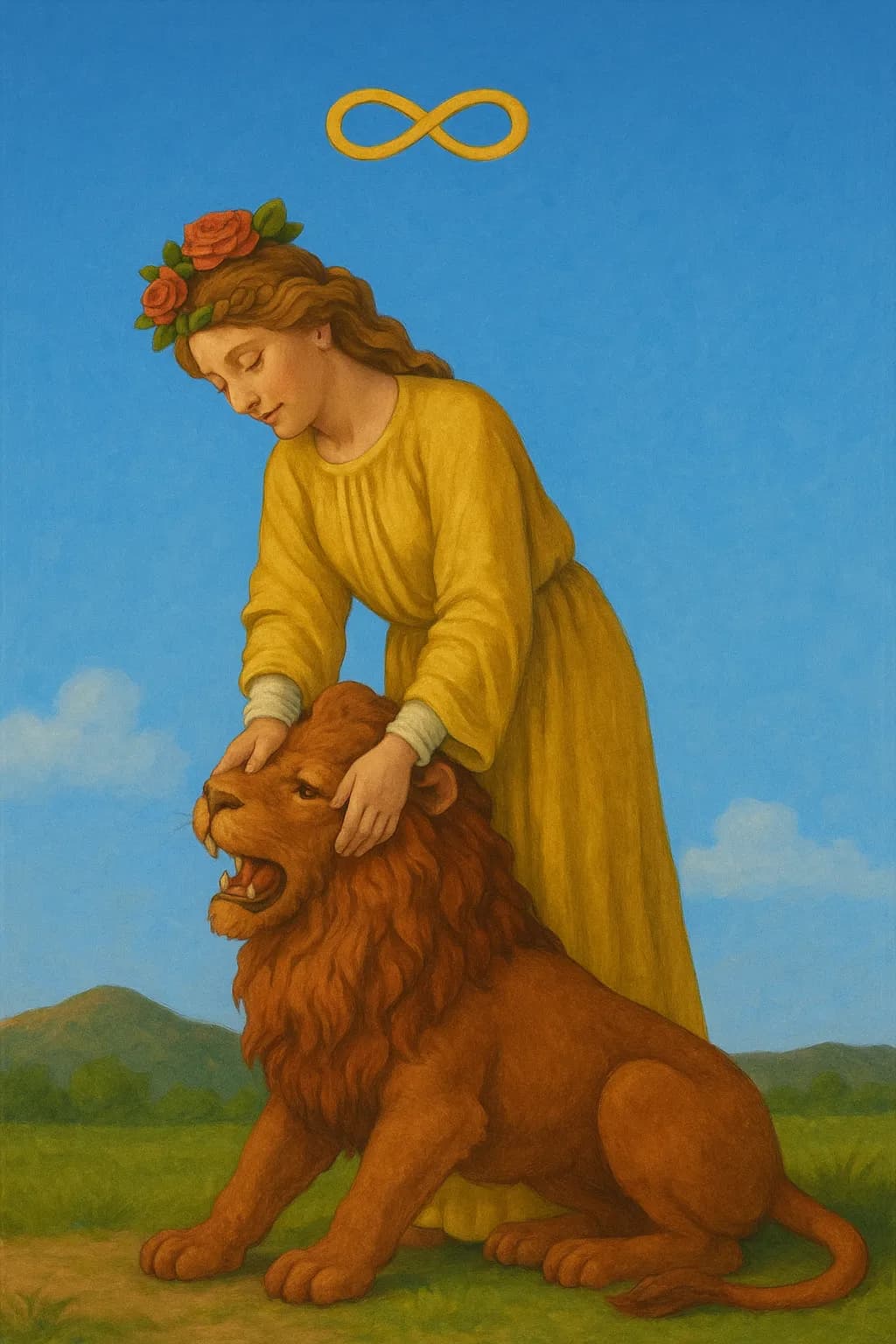 Tarot arcanaStrengthBoth the number and the card are about power that rests on composure: the Eight moves large resources and many people not by force but by calm control, like the hand resting on the lion's jaw on the card.What Strength reveals →
What it means
Maturity number 8 most often shows up like this: by thirty-five or forty the old fuel — turnover, titles, growing figures in the accounts — still works, but stops feeding you. The question "how do I earn and lead even more" gives way to the question "what of all this would stand without me." This is not the eight's engine stalling, it is the engine turning around: the first half of life proved you were capable, the second asks you to turn the accumulated power and resource into something that will outlast its owner.
In practice the turn is concrete. Money stays a measure, but a second measure joins it — influence that cannot be counted in cash: a reputation, the people you grew, the industry you moved. You stop wanting to open a tenth venture and start wanting to consolidate and protect what already stands: a board seat instead of running operations, a stake in someone else's business instead of your own startup, a fund or a teaching chair instead of one more deal. Control over the processes gives way to control over whom you hand them to.
The main risk of this turn is failing to notice it and going on cranking up turnover out of habit. A simple test separates the mature eight from the burned-out one: from her effort, something keeps standing without her daily pressure — a team that decides on its own, an asset that runs without hands-on management, a successor who carries the load. But if the scale grows while nothing can be let go and there is no longer enough left over for your health, the turn was missed: the eight's engine is spinning in neutral, and it needs to be aimed not at new peaks but at the question of what the peak is for.
Strengths
- Power as a tool, not a goal. By maturity you stop chasing a title for the title's sake: the influence you accumulated becomes a lever you use to move the work, not a way to prove you are worth something. That frees you from the eight's old dependence on the outward badges of success — the bigger office, the bigger number.
- Capital that works on its own. The second half of your life is built not on new earnings but on making what you already built pay out without your daily pressure — assets, stakes, set-up processes — while peers your age are still carrying every deal by hand.
- A ready foundation for mentoring. Over twenty years you walked the road through crises, capital and managing people that others are only starting, and they now come to you for those exact answers — solid ground for the role of mentor, board member, investor.
- You see the whole system. Experience taught you to read not a single deal but the whole structure: where the money sits, where the risk hides, who holds what together. By maturity this fires faster than calculation — a read on the money and the leverage that lands before other people's versions do.
- You can let go of the levers. The mature eight learns what she could not in her youth — to hand over not a task but real authority over money and people, and to step calmly aside once the successor carries it instead of clawing the control back.
- Scale without the scramble. Other people's urgency no longer shifts your priorities: you are used to pricing what a "burning" matter actually costs in money and risk, and you calmly turn down what turns out, once counted, to be a trifle dressed up as a crisis.
Challenges
- Cannot let go of control. By forty the business has grown, but every decision still runs through you and the team does not grow — because letting go of the lever is frightening: "it falls apart without me." Behind it sits the eight's habit of measuring reliability by her own presence. Give one person real authority and a budget for a month and do not step in until they ask — that way you see who actually carries the load.
- Still measures everything in money. The second half brings questions that do not count up as profit — relationships, time with the people close to you, your own health — and the eight, out of habit, rates them by their return and shelves them as "unprofitable." Put two items with no cash return into the same planner where your meetings live — a visit to your parents, a checkup — and treat them like commitments to a business partner.
- Cranks up turnover out of inertia. A tenth project gets launched not because it is needed but because stopping feels unfamiliar: the eight drowns the emptiness of what she has achieved in fresh scale. Before entering a new venture, write down what it adds to what you have already built; if the answer is only "even more," it is an escape, not growth, and worth shelving.
- Harsh on whoever produces less. Over the years your bar for output rises, and you demand the eight's pace and the eight's numbers from the team and the people close to you without noticing the weight of it. They burn out or leave, and you file it under their weakness rather than your pressure. Once a week give one person feedback that starts with what they did well — and put any demand as a task with a deadline, not as a grievance about their results.
- The business ate everything else. By maturity the work takes up so much room that nothing is left for family, friends or your body, and the eight notices only once her health or the people close to her start signaling. Set aside one evening a week with no work calls and no screens, and spend it at home — put it in the calendar as firmly as you would a negotiation.
Is your number 8?
Enter your birth date and name in Latin letters — we'll calculate and check.
In intimacy
In a partnership that settled long ago, the eight's turn shows in one thing: you still provide, decide and hold everything together — but your partner stopped needing the provision a while back and now wants your presence. In the first half of life you proved your worth through the work, and closeness quietly slid into second place. The turn of maturity in a relationship is a re-weighing of what you bring home: what matters to your partner is not the size of the income but how many hours you are in the room and not silently counting the income you forgo while you sit there.
If you are on your own in these years, late connections form differently than they did when you were young: you are drawn not to someone you have to lead and bankroll, but to an equal — a person with their own work, their own weight and their own money, beside whom you need neither prove your status nor guard against being used for it. A late bond under maturity number 8 holds firmer than the early ones, because it rests on a partnership of equals rather than on the role of provider.
- For the eight: once a week, set a fixed block with your partner during which you are unreachable for work — phone in another room, no "let me just answer this one." Two hours where you are present and not pricing the meeting against the deal you are missing does more than any gift.
- For the partner: do not compete with the eight at work and do not belittle her work — name concretely what you are missing: "I need one evening a week with just you," not "you're always busy."
- For the eight, if you are on your own: look for an equal where people of your level and interests gather — an industry circle, a club, a shared venture — not where your status and your money become the first thing people see in you.
Where it comes alive
After thirty-five the eight's career fork looks like this: either "more of the same" — fresh turnover, new assets, one more layer of operational control — or "a level up," toward building not a result but a system that produces results without you. The first branch runs, more and more with age, into your health and into the impossibility of ever letting go; the second turns accumulated power into an institution — a board, a fund, investments, a successor. The turn of maturity is the moment to honestly choose the second.
The practical step is to name what of all you have built must outlive your daily control, and to formalize the handover: move yourself out of operations and into strategy, pass the business to a successor while keeping the capital and the direction, package your experience into mentoring or investment. Age works for the eight here — in ownership, capital management and mentoring, the weight of a name and a track record only compounds.
Where it gets hard: rank-and-file worker with no authority to decide — for an eight used to commanding resources, working with no lever of influence becomes unbearable by maturity · line specialist inside someone else's rigid hierarchy — a ceiling with no path to scale or capital chokes her main engine · creative profession with unpredictable, unstable income — no control over the result or the money keeps the eight in constant tension · fixed-salary work with no link to the outcome — when effort makes no difference to the scale or the earnings, the eight's motivation runs dry.
Which numbers it resonates with
Number 8 in their lives
Built the scale of his name and a fortune around his art: in his lifetime he became the most expensive and most prolific painter of the era.
A long game played for results and power through endurance rather than force: 27 years in prison, and then the reordering of an entire country.
Reduced the chaos of the elements into a single system and worked on industry, weights, and measures, organization on a vast scale.
Carried the vision of 'And Quiet Flows the Don' through twenty years to the end, and to the Nobel Prize in Literature.
Launched the White Diamonds fragrance line, one of the best-selling celebrity perfumes in history.
Produced her own films and kept control over her projects.
Life path numbers are calculated from the full date of birth.
What to try today
- Give one employee real authority and a budget this week, and do not step in until they ask you to.
- Put two items with no cash return into your work calendar today — a medical checkup and time with the people close to you — and treat them like a negotiation.
- Write down today what of all you have built must run without your daily control, and name one person who could lead it.
- Set aside one evening this week with no work calls and no screens, and tell the household about it today.
- Before you enter a new project, write down on paper what it adds to what you have already built, beyond the word "more."
Number 8 in other roles
Short and to the point
Add your Life Path number and your Expression number and reduce the sum to a single digit or a master number: for example, Life Path 4 and Expression 4 give maturity number 8. The tie to age is no accident — the Life Path and the Expression have to play out before their sum can begin to work. That is why the eight of maturity is barely audible at twenty-five and rings at full strength after thirty-five, when there is finally something to consolidate and someone to hand it to.
It sounds like the eight's turn: growth itself has stopped being the goal, and you feel the emptiness precisely when everything looks fine from outside. The test is simple — if your energy comes back not from a new deal but from building what works without you (a team, an asset, a successor), that is a turn inward, and it is worth setting up deliberately. But if nothing brings you joy and you have no strength anywhere, that is a question for a doctor and for rest, not for numerology.
No. The eight of maturity changes not the volume of your work but its purpose: from producing results to preserving and passing them on. Easing into retirement is actually the hard part for her — idleness wears an eight down faster than overload. This is about a different scale of power — over the system rather than over operations: you stop personally pushing every process and start building what rolls forward without your daily pressure.
Without conflict: the Life Path is the whole road, the Maturity Number is where it turns after the midpoint. If your first half went by with no real pull toward power and money, the eight will not turn you into a dealmaker — it will ask you to bring order and take responsibility for what you hold dear: the family budget, a project, the work of people close to you. Gentler numbers find the turn harder, because the urge to take charge feels foreign to them; start small — take responsibility for one area that is in a mess right now.
There is no hard date. The first signals usually arrive between thirty-five and forty: what you have achieved stops pleasing you the way it used to, and the question "what will remain after me" surfaces more and more often. By forty-five or fifty the direction is plain. The sooner you make room for it — start growing a successor, formalizing assets, building what will outlive your daily control — the less the second half feels like a race with no finish line.
All your numbers — together
Your six core numbers from your date and name, and how they work together — in a personal reading with a numerologist.
What else unlocks Taroruna

Online spreads — an answer to your pressing question in minutes.

Today's forecast for your sign — a quick check-in with the sky.

Your personal birth chart — character, talents and destiny.

Moon phases and favorable days for important matters.