Maturity Number 3 for men and women: meaning, characteristics, compatibilityBy midlife, the Three's voice finally finds its channel
Your Maturity Number is the sum of your Life Path and your Expression Number, and it points not to your character but to the direction of life's second half. For maturity number 3, the meaning is clear: somewhere after thirty-five or forty, the scatter of your younger years recedes, and out of all those half-finished conversations, hobbies, and ideas, a single voice of your own starts to gather. That urge to be heard is not something to suppress but something to shape into finished work.
The essentials
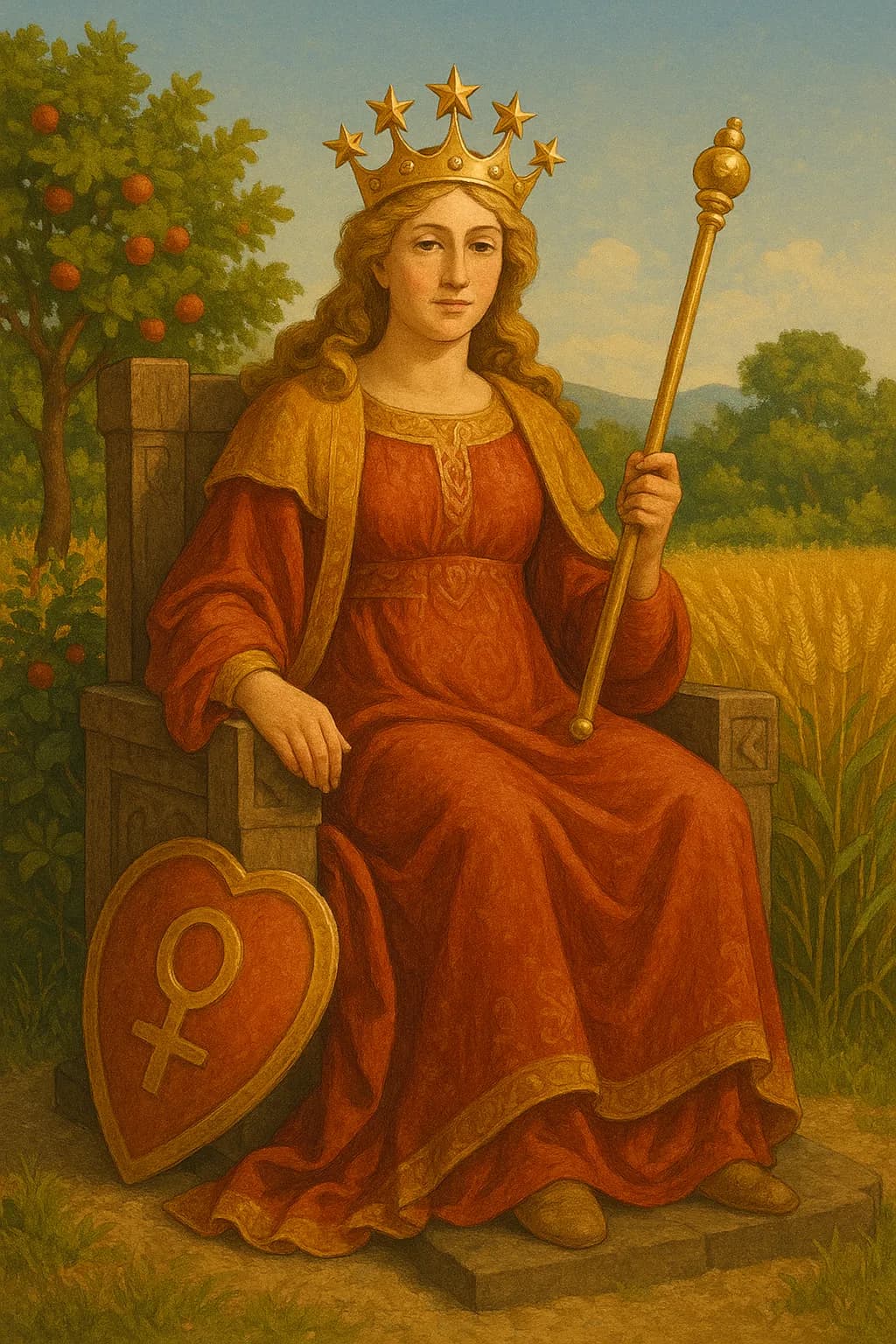 Tarot arcanaThe EmpressThe Empress creates without strain — ideas and beauty are born from her as naturally as speech; the same effortless fertility drives the Three, who finds it easier to express an idea than to keep it bottled inside.What The Empress reveals →
What it means
Maturity number 3 tends to announce itself this way: by your late thirties or early forties, it becomes obvious that you had plenty of talent but little you actually carried to the end. What looked like liveliness in your twenties — a dozen hobbies, easy charm, a fountain of ideas — turns into a suitcase full of things started and dropped. And instead of grabbing for the next new thing, you feel pulled to finally say one thing all the way through: to write it, perform it, teach it, to shape what you've gathered into a finished piece. This is not your appetite for life fading. It is that appetite coming into focus.
In practice the turn shows up like this. You feel the pull to express yourself out loud — in words, in your voice, with your hands. A subject or a craft appears that you want to pour your seasoned experience into, not just chat about over coffee. The old lightness doesn't disappear, but alongside it stands a new wish: that what you say should outlast the saying of it. After a conversation, a piece of writing; after an idea, a made thing; after a dinner with friends, more than just a good mood that evaporates by morning. Your sociability stops being a way to be liked and becomes a way to pass something on.
The main risk of this turn is staying stuck in the old setting: describing your plans more brilliantly than you ever execute them, and letting one more beautiful idea stand in for the finished work itself. A simple test separates the mature Three from the one who never grew up — after a year of self-expression, is there something you can point to: a book, a course, a workshop, a circle of people gathered around you? If it's still all 'I'm about to start' and 'I have a great idea' while your hands are empty, the turn hasn't happened — and the way back to it runs not toward a new idea but toward finishing at least one old one.
Strengths
- A voice instead of scatter. By this stage, one pursuit gets selected out of the dozen — the one you want to speak into seriously. The energy that used to run off in every direction collects into a single channel, and that is exactly when people start to actually hear you instead of just enjoying you.
- Lightness backed by experience. The old charm is still there, but now lived years stand behind it: you can make something complex sound simple and never dull. That knack for being clear without being heavy grows rarer with age, and a Three is one of the few who keeps it.
- The pull to finish. For the first time the Three feels an inner need not just to begin but to carry through — to leave a made thing behind rather than a pile of plans. That shift from starting to finishing is exactly what turns a Three's youthful liveliness into results other people can use.
- Teaching and igniting. What you've accumulated wants to be passed on, and a Three does it with real appetite — a subject comes alive next to you because you explain for the pleasure of it, not out of duty. People come to a mature Three to learn precisely because the lesson never feels like a lecture.
- A warmth proven by years. In your youth your optimism read as not taking things seriously — 'easy for you to say.' By midlife the same warmth lands differently: the people close to you watched you keep your humor through hard years and losses, so your knack for not letting gloom take the evening now reads as proven resilience, not naivety. That's why people lean on a mature Three precisely when they themselves are struggling.
- A word that holds a circle together. People naturally gather around a Three — for dinner, for a project, for a shared undertaking. By midlife this becomes a real resource: you can connect very different people through conversation and keep them in the same room long after the first reason to meet has passed.
Challenges
- The plan instead of the finished thing. After forty it's easy for a Three to live from idea to idea: each new one shines brighter than the unfinished old one, so a warehouse of started things quietly piles up for years. Underneath sits the fear that the finished work will turn out duller than it sounded in your head. Pick one unfinished project and carry it to a state you can actually hand to someone before you let yourself start the next.
- I talk more than I do. A mature Three gets listened to, and describing a plan is far more pleasant than executing it — out loud it's practically done already. So the people close to you slowly stop believing your announcements. Make it a rule: say a new plan out loud only after you've taken the first real step toward it, never in place of that step.
- Working only for the response. With age the stages where a Three used to be heard grow fewer, and the silence reads as 'I'm not interesting anymore' — under it lies a long dependence on outside approval. Once a week, finish a piece of work without publishing it or showing it to anyone. Doing it tests whether you make things for the work or only for the reaction, and slowly moves your footing off the number of listeners and onto the thing itself.
- Drama out of nothing. A Three can tell a story so well that a small mishap sounds like a catastrophe, and by midlife that talent wears the people close to you down more than the actual events do. Before you pour it out on emotion, separate the fact from the performance: state what literally happened in one sentence, with no exaggeration, then tell it however you like.
- Shallowness dressed up as range. A Three's ease at skimming the surface of everything is exactly what keeps it, with age, from ever becoming a master — a little about everything, nothing in depth. Pick one subject and this year go deeper into it than is comfortable, without bailing at the first interesting fork that leads somewhere new.
Is your number 3?
Enter your birth date and name in Latin letters — we'll calculate and check.
In intimacy
In a couple that's been together a long time, the Three's turn shows up as a growing need to be heard about more than the household — about what you make and set in motion. For a Three, the maturity shift in a relationship is really a request that your partner become your first audience: not an appraiser, not a critic of your plans, but someone who takes plain joy in your finished work beside you. When that's missing, a Three goes looking for response elsewhere — in company, new hobbies, an audience — and the couple drifts apart without a single fight.
If you're single during these years, the bonds that form gather around a shared undertaking and a shared sense of humor: a Three is drawn to someone it's easy to talk with and to build something with, not merely to spend quiet evenings beside. A late bond for maturity number 3 holds not on the brightness of the first months but on the fact that, next to this person, your ideas finally find a listener and theirs find a real one in you.
- For the Three: once a week, show your partner one specific finished thing instead of retelling your plans. A completed result brings you closer than any account of what's only been dreamed up.
- For the partner: when the Three shares a plan, don't rush to pick at its weak spots — first ask why this particular idea matters to them. Early criticism snuffs it out and sends them to look for response somewhere outside the couple.
- For the Three, if you're single: this month, go where people make things with their hands or their words — a workshop, a conversation club, an amateur stage. A Three's later connections start over a shared undertaking, not over small talk.
Where it comes alive
After thirty-five, the Three's career fork is stark: stay the generalist who starts everything and settles nowhere, or gather what you've accumulated into a single craft where people know you by name. The first branch loses value with age — the market stops paying for breadth without depth. The second turns your lived years and trained eye into an authorial voice, the one thing your younger competitors haven't earned yet. The maturity shift is the moment to choose the second branch on purpose.
The practical move is to name the work you have both something to say and something to show in, and to make it public: your own school or course, a book, a column, a workshop, talks from a stage. Here age is on a Three's side — in any trade that prizes the living word and seasoned taste, experience adds weight instead of being written off as out of date.
Where it gets hard: accountant or reporting specialist — monotonous work with no live contact and no public outlet snuffs a Three out faster than any amount of overtime · assembly-line operator or worker in a strictly scripted process — there's no room for a word, for improvisation, or for a voice of your own · archivist or solo records-management specialist — the silence and the missing audience strip a Three of its main fuel · analyst whose work vanishes into closed reports — the labor is neither seen nor heard, and a Three needs what it makes to land on someone.
Which numbers it resonates with
Number 3 in their lives
He turned the pain of an era into living, speaking words — poems and Doctor Zhivago: a voice sent outward where it would have been safer to stay silent.
He made a spectacle of himself: the moustache, the manifestos, the provocation — personality as his chief work and his way of speaking to the world.
His dancing in Saturday Night Fever made him a star: charm and movement as a message that needs no words.
A voice that fills a stadium: pure emotion delivered out loud to millions — self-expression as a profession.
She built her name on vocal range and the stage: since her teens her instrument has been her voice and open self-expression.
Life path numbers are calculated from the full date of birth.
What to try today
- Pick one unfinished project and carry it, today, to a step you can actually show someone.
- Write down today one subject you have something to say about, and sketch three opening points for a future course, piece, or talk on it.
- Today, show someone close to you one finished thing instead of telling them about a plan.
- About a new idea that came to you today, stay quiet until tomorrow — instead of announcing it, take one real step on it first.
- Cancel one meeting today in favor of an hour on your own work, and spend that hour finishing something, not starting it.
Number 3 in other roles
Short and to the point
Add your Life Path Number and your Expression Number and reduce the sum to a single digit or a master number: for example, Life Path 1 and Expression 2 give Maturity Number 3. The tie to age is no accident — the path and the expression have to play out before their sum can switch on. That's why a Three's maturity is barely audible at twenty-five and grows louder after thirty-five, when the scatter of youth leaves behind a wish to say one thing all the way through.
It fits the classic Three picture: accumulated experience asking to come out in words, with the pull toward public self-expression as the most reliable sign. The test is simple — if you have more energy after telling, writing, or showing something rather than less, this is a real turn toward self-expression and worth setting up properly. But if you're drawn only to talk about the plans and not to do them, start with one small finished thing: it will show you fast whether this is a calling or a pose.
No. A Three's maturity is about the need to be heard and to leave finished work behind, and the form that takes varies. Some need a stage; for others it's enough to teach a single student, run a column for their own circle, or make things that pass into the hands of people close to them. What matters is not the size of the audience but that your voice finds a channel and the work gets finished instead of piling up as plans.
Without conflict: the Life Path is the whole road, while the Maturity Number is where that road turns after the midpoint. If the first half went by in work and quiet, a Three won't undo that — it will ask you to let out what you've stored up, so the silent specialist grows into someone who finally shares: writes, explains, passes things on. Reserved numbers find this turn harder, since speaking out loud can feel undignified to them. Start small — one piece of writing, one talk for your own circle.
There's no fixed date. The first signs usually arrive between thirty-five and forty: the collection of things started and dropped begins to weigh on you, and out of all your interests one stands out that you want to invest in seriously and carry to a result. By forty-five to fifty the direction is obvious. The earlier you give it room — finish one thing, step out to people with a word of your own — the gentler the transition, and the less unfinished work ends up forgotten in a drawer.
All your numbers — together
Your six core numbers from your date and name, and how they work together — in a personal reading with a numerologist.
What else unlocks Taroruna

Online spreads — an answer to your pressing question in minutes.

Today's forecast for your sign — a quick check-in with the sky.

Your personal birth chart — character, talents and destiny.

Moon phases and favorable days for important matters.