Upright, the Six of Swords confirms that the choice to leave was right and the move is already working. In daily life it is the resignation letter handed in, the boxes taped shut, the one-way ticket, the first week in a new place where the quiet still feels strange. The card lowers an inflated expectation: there is no joy at this stage, and that is not a fault in you. The honest emotion of a crossing is tired relief; the pleasure of the new place comes later, with distance. The practical reading: take help from someone who knows the water — a friend with a car, a lawyer, a therapist — and don't try to erase the old shore by willpower. The swords ride along with you; it's only in calm water that they stop cutting.
Six of Swords Tarot Card Meaning
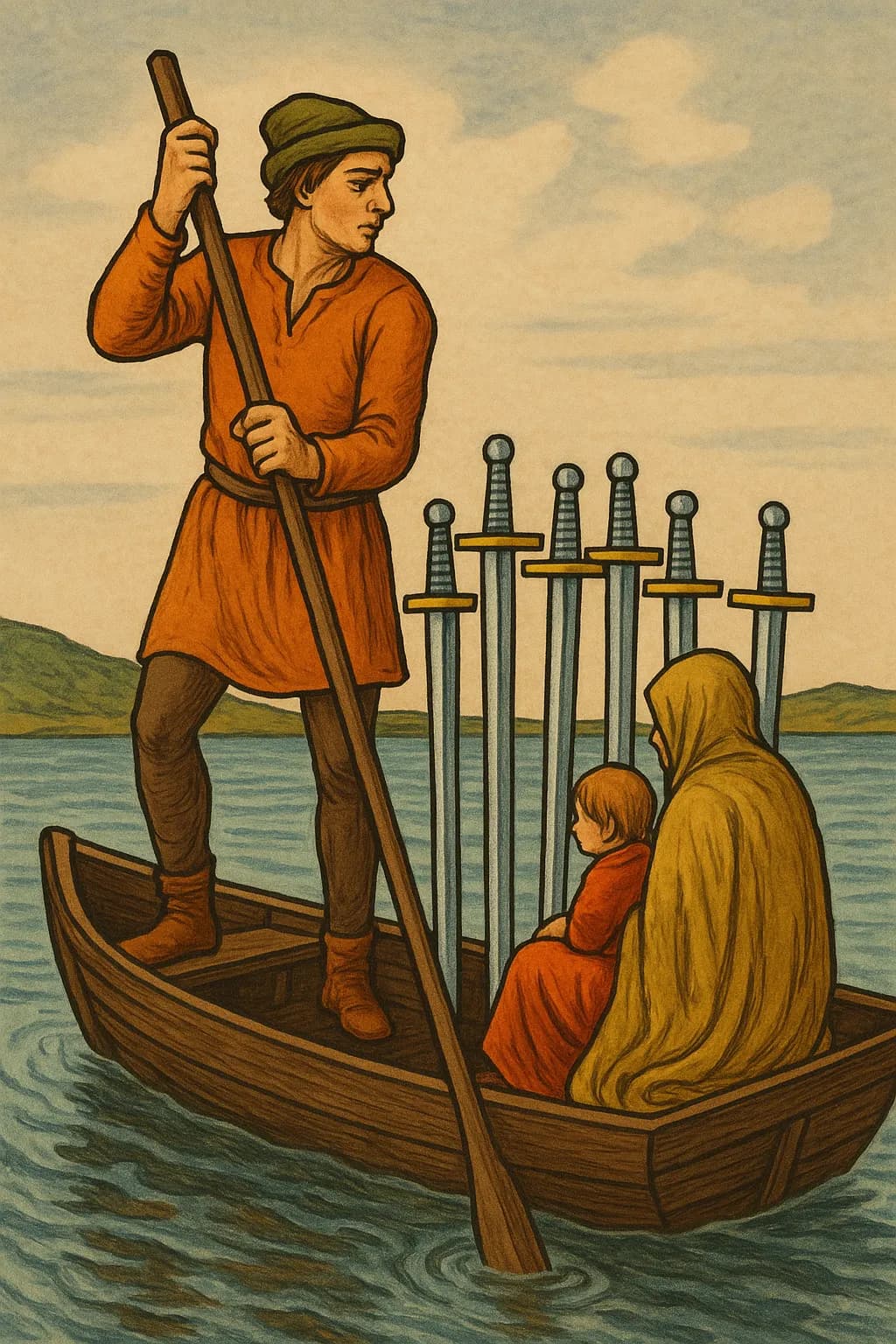
Six of Swords
The Six of Swords is the card of the crossing and the quiet departure. In the Rider-Waite-Smith image a ferryman stands in the boat and pushes off with a long pole; with their backs to us sit a cloaked, hooded woman and a child beside her, and six swords stand upright in the bow. The water off the right side runs choppy; ahead, on the boat's course, it lies smooth, and a far shore lined with trees is already in view. The worst is behind, the new has not begun, and for a stretch a whole life fits into one boat.
SwordsThe swords were not thrown overboard — they travel with the passengers, and that is the card's central key. The experience of a hard chapter can't be unloaded on request, only carried across; there is a harsher reading too: pull the swords out and water floods the holes they leave, so pretending none of it happened is what sinks the crossing. The passengers don't look back and don't show their faces — the past hasn't finished hurting, but the boat is already moving. The ferryman is help that was accepted: this passage isn't made alone on willpower. And the gap between the chop at the side and the calm on the course is the card's honest promise — relief arrives not at once, but with distance from the shore.
The first weeks after a divorce, when the sharp pain has gone and left a flat emptiness; moving out of a city tied to too much; leaving the team that burned you out; switching a child to a new school after bullying; finishing a course of therapy that left you not happy but quieter — this is all Six of Swords ground. What these share is relief without celebration: the decision is made and underway, and the only thing left is to arrive. The card surfaces not at the moment of choosing but mid-journey — cast off from the old shore, not yet landed on the new — and the one real task is to not turn the boat around in the middle of the water.
Upright Meaning
Reversed Meaning
The resignation letter has been written for months and sits in a drawer; the moving date has slipped for the third time; every evening you reply to messages from the other shore — an ex, a former boss — and each reply swings the boat back around: this is what a crossing that never leaves the bank looks like. There is the opposite tilt too — casting off too hard: the city, the job, or the partner changes inside a week, and a month later the same plot replays in the new place, because you fled the people without sorting out your own part in the trouble. You can tell a real move from a flight with one question: what changed besides the address? If the answer is 'nothing,' you didn't ferry your things across, you ferried the script — and the next move won't cure that either.
Six of Swords in love: cast off without slamming the door
After a breakup, the Six of Swords reads as the right kind of distance: not blocking in a flare of anger, not 'staying friends' from day one, but removing the reasons to be in touch — return their things, close out shared business, mute the stories. The hardest hour to hold course is the evening: checking an ex's profile carries you back to that shore more reliably than any meeting would. Starting a new relationship mid-crossing is a bad idea — a partner taken on 'to drown out' the last one gets cast as the ferryman, an unfair role to hand a real person. Within a couple, the card is the way out of a long storm: the fight is over, and instead of relitigating who was right, it helps more to change the scenery together — even just spend a weekend away from the apartment where the shouting happened.
Six of Swords in career: leave without burning the bridge
The work version of this card is the planned exit: the offer first, then the notice; hand off your work so people remember you without resentment; keep the two or three contacts that made the job worth it. Relocation, a transfer to another department, and stepping off a project that drained you all belong here too. Before you go, do one exercise: write down exactly what was unbearable — the tasks, the manager, the schedule — otherwise you'll pick the next job on salary alone and step on the very same rake. And don't play the hero in your first month after the move: the task of a crossing is to make landfall, not to win the regatta.
Six of Swords and well-being: recovery at the speed of a boat
After a hard chapter the body won't switch over on command: fatigue built up over months doesn't lift in a single weekend, and demanding energy from yourself on the second day of a holiday gets you nowhere. Give recovery a timeline in weeks and strip out the competing: instead of 'get back in shape,' make it walks, the pool, lights-out at the same hour. The backbone of a crossing is routine — meals and sleep on a schedule hold you better than motivation does, especially against a move or a job change. And if it doesn't grow quieter inside, talking to a therapist on this leg isn't weakness — it's the ferryman.
Six of Swords and money: price out the crossing first
Every transition costs money, and the financial meaning of the card is to price it out in advance: the deposit on the new place, the move itself, the gap between your last paycheck at the old job and the first at the new one. If you're leaving work, a cushion covering several months of expenses turns the decision from a leap into a crossing. The second storyline is exiting a money-losing arrangement: stop topping up a project that drags you down, close the credit card, restructure the debt — not in one stroke but on a plan, payment by payment. What not to do is make large investments midstream: until you've reached the shore, your money's job is to sit somewhere dull and safe.
Six of Swords: Combinations with other cards
Major Arcana
- The FoolRelocation, a journey; travel into the unknown; a random course
- The MagicianBuilding connections
- The High PriestessA family secret; gaining a fresh outlook on life
- The EmpressA difficult pregnancy
- The EmperorTrying to mend things at home or at work; changing roles or jobs
- The HierophantA good journey
- The LoversMaking a choice
- The ChariotSearching for direction
- StrengthGathering your strength
- The HermitTurning attention to yourself
- Wheel of FortuneNew feats
- JusticeSharp changes in life
- The Hanged ManMaking sacrifices
- DeathMoving toward change
- TemperanceOn the path to recovery and healing
- The DevilFalling into the Devil's clutches; indulging your vices
- The TowerSet on a path of loss and failure
- The StarFollowing an astrologer's advice
- The MoonWalking into a trap; a road into the unknown; an undertow
- The SunA search for happiness; the right path
- JudgementA reprieve
- The WorldSeeking peace; deliverance
Wands
- Ace of WandsMoving toward the light
- Two of WandsRelocation
- Three of WandsNo turning back
- Four of WandsFinding a safe harbor
- Five of WandsOut of the frying pan, into the fire
- Six of WandsMoving toward a better lot; improvement
- Seven of WandsA vain hope for peace
- Eight of WandsFlight; a breakup
- Nine of WandsA cold welcome
- Ten of WandsDrowning in problems
- Page of WandsMoving in with a son
- Knight of WandsGoing off course
- Queen of WandsGrowing closer to a woman
- King of WandsGrowing closer to a man
Cups
- Ace of CupsHeart versus head
- Two of CupsSeparation
- Three of CupsA journey together; a shared search for a way out
- Four of CupsSeeking rescue
- Five of CupsCarrying a grudge
- Six of CupsLeaving the past behind
- Seven of CupsA change of plans
- Eight of CupsMoving toward a better life
- Nine of CupsOptimism
- Ten of CupsReaching out to people; returning to family
- Page of CupsA painful realization
- Knight of CupsA painful realization
- Queen of CupsAn honest talk
- King of CupsHeart versus head
Swords
- Ace of SwordsA heated debate
- Two of SwordsA clash of minds
- Three of SwordsA clash of minds
- Four of SwordsA conflict of interests
- Five of SwordsA clash of minds
- Seven of SwordsThe truth comes out
- Eight of SwordsUnable to escape a troubled situation; the knot tightens
- Nine of SwordsA clash of minds
- Ten of SwordsA sharp mind
- Page of SwordsThe truth comes out
- Knight of SwordsWise counsel
- Queen of SwordsA critical eye
- King of SwordsWise counsel
Pentacles
- Ace of PentaclesReviewing your finances
- Two of PentaclesSmart investments
- Three of PentaclesPlanning for success
- Four of PentaclesA rational choice
- Five of PentaclesSmart investments
- Six of PentaclesA rational choice
- Seven of PentaclesReviewing your finances
- Eight of PentaclesReviewing your finances
- Nine of PentaclesSmart investments
- Ten of PentaclesPractical decisions
- Page of PentaclesA business strategy
- Knight of PentaclesA business strategy
- Queen of PentaclesA calculated approach
- King of PentaclesReviewing your finances
Six of Swords: Combinations with other cards
Six of Swords
+