Upright, the Ace of Swords means the fog has lifted: the situation can finally be stated in a single sentence, and once you've named it, you can't hide from it anymore. The best use of that clarity is to lock it down with action, schedule the conversation you've been putting off, write the idea out, sign the document, give a flat yes or no. Decisions made in this moment outlast emotional impulses, because they rest on facts rather than mood. One condition: don't water the wording down with qualifiers. The more directly it's said, the more cleanly it cuts.
Ace of Swords Tarot Card Meaning
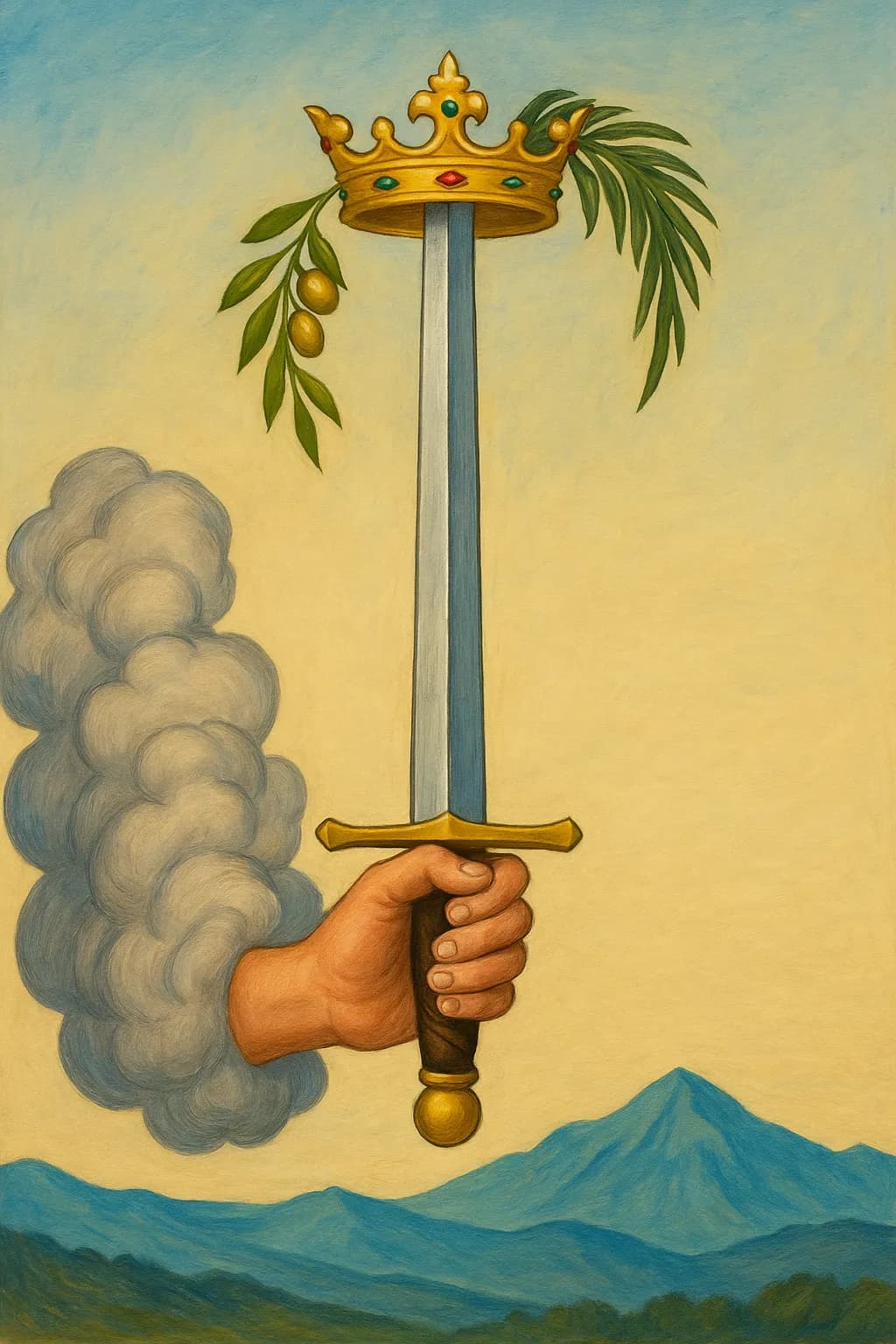
Ace of Swords
The Ace of Swords opens the suit that governs the mind, words, and decisions in tarot, and it arrives with no buildup: the thought here lands like a strike, all at once, so suddenly and so completely that arguing with it is no longer an option. In the classic Rider-Waite-Smith image a hand reaches out of a cloud, gripping a double-edged sword raised point-up; the blade passes through a golden crown hung with two branches, olive and palm, golden sparks scatter around the edge, and below lie bare grey peaks without a single tree.
SwordsThe hand emerging from the cloud means insight isn't produced by effort, it simply happens: after weeks of fog, the picture snaps into place in a second. The blade cuts both ways, and that is the card's central key: the truth slices in two directions, freeing the one who speaks it and wounding when it's swung carelessly. The crown on the point is the victory of a clear mind, but from it hang the olive branch of peace and the palm of triumph: truth has to do more than win, it has to reconcile. And the bare peaks below are a reminder that pure logic is harsh terrain: clarity gives you a direction, but not warmth.
A conversation after which no one can keep pretending everything is fine; the exact diagnosis of a situation that's been begging to be named; the idea or the wording that the whole rest of the plan gets built around, that is what the Ace of Swords looks like beyond the spread. It's the card of signed documents, filed applications, honest yeses and nos, of any step where a word locks a decision in place and shuts the door back to ambiguity.
Upright Meaning
Reversed Meaning
Reversed, the Ace of Swords shows up most clearly at night: thoughts loop on themselves, and every day brings a fresh 'final' decision that cancels yesterday's. This is clarity that never landed, or one turned to harm: the argument is fought to win rather than to understand; the truth is rationed out, technically not a lie but a distorted picture; a precise word gets aimed at someone close like a weapon; conclusions get built on hearsay and numbers with no source. The card doesn't forbid you from deciding, it asks you first to put the edge back on the blade: check where the data came from, and think the thought all the way through before you call it a decision.
Ace of Swords in love: the truth instead of guesswork
In relationships the Ace of Swords almost always points to a conversation that's overdue: define where you actually stand, spell out the boundaries, name the problem you've both been circling for months. The card sides with directness: leaving it to 'sort itself out' costs more than ten uncomfortable minutes of honesty. For single people it speaks more often to clarity about your own criteria, it gets easier to tell 'I'm genuinely interested' apart from 'I'm afraid of being alone.' Just remember: direct doesn't mean harsh. The point of the conversation is to hear what's really going on, not to win the round.
Ace of Swords in career: the idea that becomes the plan
At work the Ace of Swords is the card of framing the problem precisely: out of a long discussion a decision is finally born, a concept, a strategy, a reasoned position for a negotiation. A good time to put things into words: write the plan, defend the project, get verbal agreements down in writing, have the candid conversation with your manager or client. If you've been turning an idea over in your head for ages, set it on paper, written out, you can see at a glance where it's strong and where the holes are. Watch your tone in writing especially: clarity reads as bluntness easily when there's no voice to soften it.
Ace of Swords and health: clearing an overloaded mind
Swords in tarot are tied to the mind, and on matters of wellbeing the upright Ace most often speaks to mental overload: trouble falling asleep from replaying conversations, shoulders and jaw clenched by evening, a screen that never goes dark before midnight. The practical focus is unloading the head: write the open loops onto paper at night, close the work chats at the same time each day, leave gaps in the day with no podcast and no feed. And if something about how you feel has been nagging for a while, the card backs the principle of clarity: don't diagnose yourself by symptoms online, get it checked and know for certain.
Ace of Swords in finance: numbers instead of a hunch
With money the Ace of Swords demands you turn the feeling into figures: not 'it seems to be enough,' but the exact picture, what comes in, what goes out, and on what. A good moment to put the paperwork in order: read the contract before you sign, get verbal terms down in writing, ask the blunt question about fees and deadlines, however awkward it feels. A decision you can justify on paper in five lines is a decision; 'everyone does it this way' or 'I'll deal with it later' is an impulse, and the card advises you to hold off on it.
Ace of Swords: Combinations with other cards
Major Arcana
- The Foolthe greatest wisdom or the greatest folly; conception; an open mind; a pointless venture.
- The Magicianan ingenious idea; seizing the sword of victory
- The High Priestesswisdom
- The Empressconception
- The Emperora great business idea
- The Hierophantreceiving a reward
- The Loversclearing the air in a relationship; fighting for a relationship
- The Chariotuntangling the confusion
- Strengthstanding up for the truth
- The Hermitunderstanding yourself
- Wheel of Fortunea weight on the soul
- Justicepunishment; paying the price
- The Hanged Mancontradictions
- Deathan outdated idea
- Temperancean idea that needs careful consideration
- The Devila devilish scheme; a fixed idea
- The Towershattering false beliefs; freeing the mind
- The Stara brilliant idea
- The Moondelusions
- The Sungaining clarity
- Judgementtaking someone under your protection
- The Worlda grand undertaking
Wands
- Ace of Wandsa brilliant, inspiring idea
- Two of Wandsa project that needs thought and a weighing of prospects; a planned pregnancy
- Three of Wandsfrom idea to reality
- Four of Wandsbirth
- Five of Wandsa contentious project
- Six of Wandssuccessfully advancing a plan
- Seven of Wandsobstacles and hurdles
- Eight of Wandsan online message; catching an idea on the fly.
- Nine of Wandsan idea that raises doubts
- Ten of Wandsan unworkable project; an idea that failed the test
- Page of Wandssuccessful study
- Knight of Wandsa plan that leads us into the unknown
- Queen of Wandscreative realization
- King of Wandsmastery
Cups
- Ace of Cupsan honest conversation
- Two of Cupsuncertainty in a relationship
- Three of Cupscollective intelligence; a shared idea
- Four of Cupspessimism; gloomy thoughts; a mind weighed down
- Five of Cupsdiscord; deep resentment; a sword of Damocles
- Six of Cupsa long-held plan
- Seven of Cupsa dubious idea; a hollow victory
- Eight of Cupssearching for fresh ideas
- Nine of Cupsa happy venture
- Ten of Cupsresolving a misunderstanding within the family
- Page of Cupsemotional analysis
- Knight of Cupsemotional analysis
- Queen of Cupsrational feelings
- King of Cupsan honest conversation
Swords
- Two of Swordsthe truth comes out
- Three of Swordsthe truth comes out
- Four of Swordsa sharp mind
- Five of Swordsthe truth comes out
- Six of Swordsa heated debate
- Seven of Swordsa critical eye
- Eight of Swordswoe from wit
- Nine of Swordsthe truth comes out
- Ten of Swordsa conflict of interests
- Page of Swordsan intellectual confrontation
- Knight of Swordsstrategic thinking
- Queen of Swordsa difficult decision
- King of Swordsan intellectual confrontation
Pentacles
- Ace of Pentaclesa calculated approach
- Two of Pentaclespractical decisions
- Three of Pentaclesa business strategy
- Four of Pentaclesfinancial analysis
- Five of Pentaclespractical decisions
- Six of Pentaclesfinancial analysis
- Seven of Pentaclesa calculated approach
- Eight of Pentaclesa calculated approach
- Nine of Pentaclespractical decisions
- Ten of Pentaclesa rational choice
- Page of Pentaclessmart investments
- Knight of Pentaclessmart investments
- Queen of Pentaclesbusiness negotiations
- King of Pentaclesa calculated approach
Ace of Swords: Combinations with other cards
Ace of Swords
+