Upright, the King of Swords marks the moment when charm and pressure lose and preparation wins. This is the card of signing a contract, arguing for a raise, negotiating with a contractor, sitting an exam in front of a strict examiner: situations where you'll be asked not 'how do you see it?' but 'what backs it up?' If the question was about a person, you're facing someone who decides on the merits, where pleading for sympathy gets you nowhere but bringing the numbers is enough, and he'll be the first to take your side. If it's about you, cut 'I feel like' and 'sort of' from your speech and replace them with dates, sums, and names. A decision made against criteria you wrote out in advance is one you can later explain to others and, more to the point, to yourself a year from now.
King of Swords Tarot Card Meaning
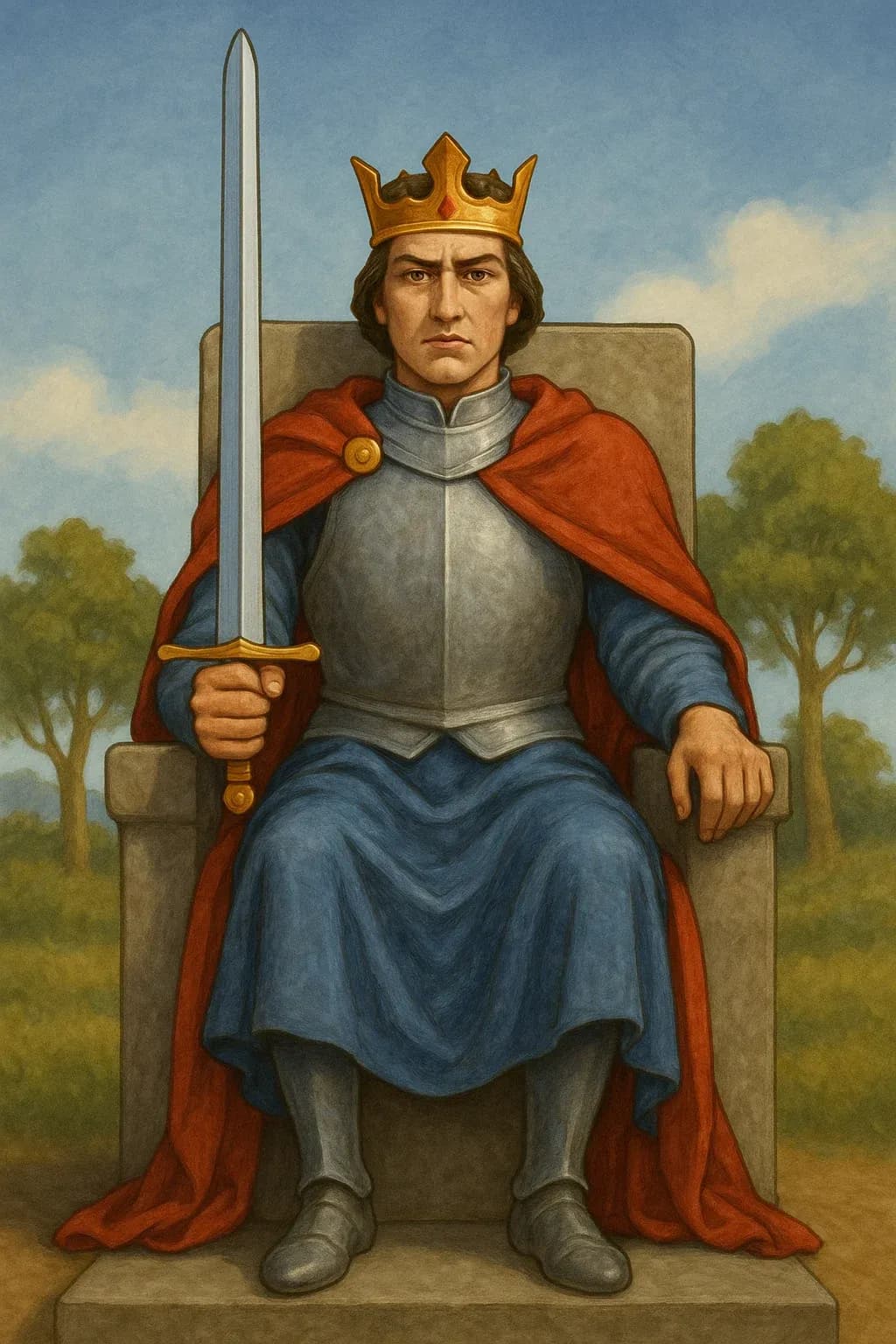
King of Swords
The King of Swords is the archetype of the judge: the man who has heard both sides and rules on the facts, not on who he likes. In the classic Rider-Waite-Smith image he sits squarely on a stone throne, turned full-face toward the questioner, in a blue tunic and violet cloak, sword raised in his right hand while his left rests calmly on his knee. Carved butterflies decorate the back of the throne, trees stand behind him, and two birds fly high in a nearly cloudless sky.
SwordsThe sword is not perfectly vertical: the slight tilt of the blade is traditionally read as an allowance for circumstance, a reminder that rigor with no room for exception curdles into cruelty. The full-face posture is that same directness made physical, a verdict delivered to your face rather than negotiated behind your back. The butterflies mark the element of Air and a matured mind, an intellect that has already passed through its transformations and no longer needs to prove itself. The high-flying birds are the view from above, seeing the whole picture instead of the one episode that stung you. The still sky behind the throne is not the absence of feeling but feeling that has settled far enough to stop distorting what he sees.
You can spot this person by a single line in a meeting: not 'who's in favor?' but 'what data backs that up?' That is how a judge, a lawyer, an auditor, a doctor who names the situation plainly, or a manager closing a hiring decision by criteria rather than by favorites makes the call. The card points either to such a person in your situation, often the one who decides (a boss, an expert, an official) whose only language is arguments rather than emotion, or to the demand that you become that person yourself: decisions have piled up that need to be made on the facts, written down, and announced to those concerned to their face.
Upright Meaning
Reversed Meaning
If a conversation left you not with clarity about what to do but with the feeling of having been told off, you're facing the reversed King of Swords. The same sharp mind, but with the ethical brakes cut: a man right to the letter and destructive in substance, who wins every argument and is slowly left without people, who demands of others rules he won't apply to himself, who criticizes not to help but to put his own superiority on the record. That same intellect slips easily into the service of manipulation: facts get twisted, quotes pulled out of context, a contract legally flawless and dishonest all the same. The card also catches you yourself: when the decision was made long ago and the 'analysis' is only assembling arguments for the answer you already wanted, your sword is already pointing tip-down.
King of Swords in love: respect that runs short on warmth
For the single, this is the card of a person who doesn't play games: he says plainly what he wants, doesn't vanish without explanation, and answers questions honestly, but don't expect spontaneous romance from him. His attention shows up as action: he came, he handled it, he fixed it, he remembered what you said a month ago. In a couple, the King of Swords is the on-the-merits conversation that keeps getting put off (about money, about who carries which chores, about plans for the year), and one clear agreement heals more here than ten rounds of 'but what did you actually mean.' The card's trap is a relationship turned into a rulebook: everything fair, everything on schedule, every argument won on points, while closeness loses, because a plain 'I missed you' isn't a clause in the rulebook.
King of Swords in career: the one who brought the numbers decides
At work this is the card of decisions on the merits, and of the people who make them. If you're waiting on an answer from a manager, an investor, or a committee, prepare not an emotional pitch but a short document: numbers, deadlines, risks, the proposal; it's easier for this kind of person to say yes to someone who spared them the time of checking. If the deciding role is yours, settle disputed and personnel questions by criteria announced in advance and deliver them in person, not over a mailing list. The card favors professions where precision is the product: law, analytics, engineering, medicine, finance. Advancement under the King of Swords runs through the reputation of someone whose word is exact: if he said it, no one needs to double-check.
King of Swords and health: the head that gives the body no say
This card's strength is discipline: a King of Swords person can hold a regimen, a schedule, a prescribed course all the way to the end, and that's worth putting to use. Set rules you can actually check: not 'rest more' but 'lights out by midnight,' not 'stress less' but 'twenty minutes of walking after the work call.' The weak spot is the body treated as an afterthought: fatigue and tension feel 'illogical' and so get ignored to the limit, while the evening goes to replaying arguments from a fight that never happened. Treat the body's signals as data, not as interference: a headache by evening and broken sleep are statistics worth logging and showing a specialist, not overriding by willpower.
King of Swords and money: what's in writing versus 'but we agreed'
In finances this is the card of documents: read the contract in full before signing, including the fine print on penalties and termination; put agreements in writing, especially with friends and family, because that's exactly where 'it's obvious, surely' ends in resentment. In a money dispute your strength is paper: the correspondence, the receipts, the signed acceptance forms; emotional arguments don't work here, documents do. Vet large purchases and investments against criteria set in advance, not against the mood of the day: a cap, a purpose, a deadline. The card's trap is over-drying the system: a budget with not a cent allowed for pleasure is mathematically flawless and therefore broken on a regular basis.
King of Swords: Combinations with other cards
Major Arcana
- The FoolConflict with a child
- The MagicianStrategy in action
- The High PriestessMastering knowledge
- The EmpressConflict with a wife
- The EmperorConflict at work or at home
- The HierophantIntellect, too, can be a heavy burden
- The LoversA relationship crisis
- The ChariotGetting your way at any cost
- StrengthCunning
- The HermitSolitude; ideas that fall on deaf ears
- Wheel of FortuneFlexibility
- JusticeA very malicious person beside you who can't be trusted
- The Hanged ManTo impose punishment
- DeathA widower; sorrowful change
- TemperanceMental adjustment
- The DevilCruelty
- The TowerDivorce; loss; material damage; loss of authority
- The StarHope for improvement; making your way by force of intellect
- The MoonLosing your mind; illness
- The SunMental renewal; an idea that wins recognition
- JudgementA judge, lawyer or attorney
- The WorldA new project
Wands
- Ace of WandsPointing the way
- Two of WandsTo calculate
- Three of WandsThe brains of the project
- Four of WandsDivorce
- Five of WandsAuthoritarianism; trying to dominate others
- Six of WandsA shrewd, cool-headed leader
- Seven of WandsTo parry; to meet with arrogance
- Eight of WandsGiving an order
- Nine of WandsPhysical danger
- Ten of WandsAbuse of intellect
- Page of WandsUnwelcome news
- Knight of WandsBrainstorming
- Queen of WandsDivorce
- King of WandsTo ignore
Cups
- Ace of CupsAn honest talk
- Two of CupsColdness in the relationship
- Three of CupsMeddling in others' affairs
- Four of CupsWeighed down by an authority figure
- Five of CupsRuthlessness
- Six of CupsA difficult childhood
- Seven of CupsScheming
- Eight of CupsSeeking common sense
- Nine of CupsRuthlessness
- Ten of CupsGuarding the family's interests
- Page of CupsEmotional analysis
- Knight of CupsEmotional analysis
- Queen of CupsReasoned feelings
- King of CupsAn honest talk
Swords
- Ace of SwordsIntellectual confrontation
- Two of SwordsHeated debate
- Three of SwordsWise counsel
- Four of SwordsLogical analysis
- Five of SwordsA tough decision
- Six of SwordsWise counsel
- Seven of SwordsStrategic thinking
- Eight of SwordsUnder someone's control
- Nine of SwordsA sharp mind
- Ten of SwordsA critical eye
- Page of SwordsMental clarity
- Knight of SwordsStrategic thinking
- Queen of SwordsHeated debate
Pentacles
- Ace of PentaclesA calculated approach
- Two of PentaclesPractical decisions
- Three of PentaclesBusiness strategy
- Four of PentaclesFinancial analysis
- Five of PentaclesPractical decisions
- Six of PentaclesFinancial analysis
- Seven of PentaclesA calculated approach
- Eight of PentaclesA calculated approach
- Nine of PentaclesPractical decisions
- Ten of PentaclesA rational choice
- Page of PentaclesSmart investments
- Knight of PentaclesSmart investments
- Queen of PentaclesBusiness negotiations
- King of PentaclesA calculated approach