Upright, the Five of Wands drops you into a field of equals where everyone is grabbing for the same thing: a tender with several contractors bidding, a contest for a position, a brainstorm where ideas keep cutting each other off, a department where two people are eyeing the same promotion. There's less hostility here than it looks: nobody wants to destroy you, but nobody intends to back down either. The card confirms the contest is fair and worth entering — the spot won't fall to you by default, and staying quiet won't save it. What decides it isn't volume but preparation: a clearly stated goal, two or three arguments that bear on the substance, and a steady tone cut through the general din faster than sheer force. And remember — today's rivals in the tender are tomorrow's partners, so your conduct in the argument is worth more than any single win.
Five of Wands Tarot Card Meaning
Five of Wands
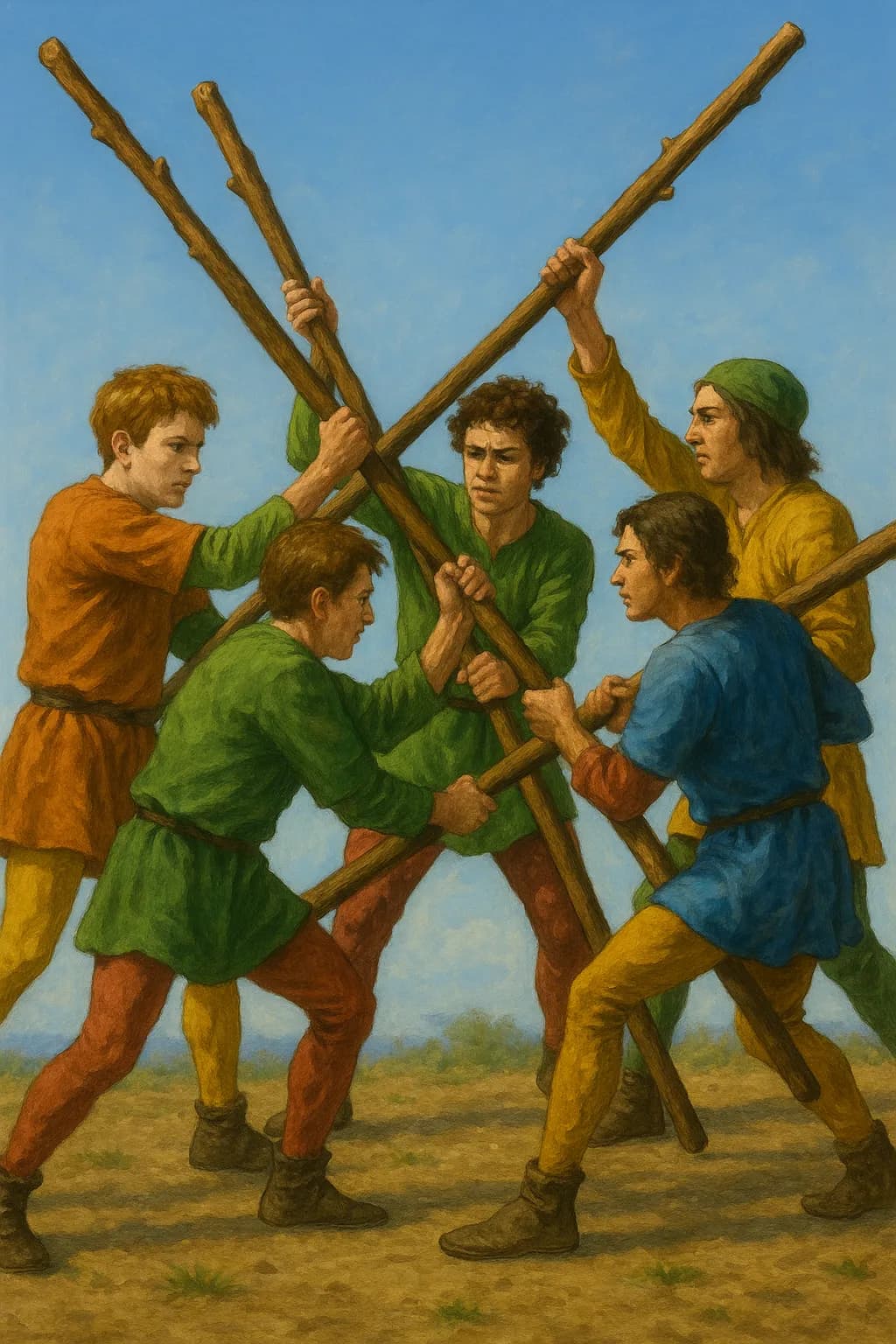
Open rivalry among equals — that's what the five young men on the Rider-Waite-Smith card are acting out: they brandish long staves, the wands cross in midair in total disarray, blows coming from every direction. Look closer, though — no blood, no wounds, not one angry face. All five are dressed in different colors and cuts, the sky is clear, the ground bare and level: there's no outside enemy here, the whole scuffle was started by the participants themselves. Each one is fighting for his own corner, everyone talks at once — and nobody is listening to anybody.
WandsJust one card earlier, on the Four of Wands, the staves stood in a festive garlanded arch — shared order and agreement. In the Five that order comes apart: the five wands add up to no shape at all, because each one is pulled a different way. Wands are the suit of initiative and ambition; five ambitions crammed onto one small patch of ground collide, even when nobody means anyone harm. And the absence of wounds is the key tell: this is a sparring match, not a war. The participants test each other's mettle and come out of the test stronger, not broken.
A planning meeting where five people each defend a different decision and talk over one another. A job opening that equally strong candidates are all chasing. A work chat where a debate about the project slides into a contest over who's more competent; a family council about a renovation where everyone has their own plan and nobody gives an inch. The common thread in these situations is rivalry among equals with no referee and no rules: lots of noise, little movement. The winner is usually not the loudest, but the first to remember what it all started for and to propose some order — by turns, by criteria, by substance.
Upright Meaning
Reversed Meaning
Where did the argument go, if out loud everyone agrees? Reversed, the Five of Wands shows a conflict that hasn't ended, only changed shape. Most often it goes underground: at the meeting you nodded, by the coffee machine you're fuming, and the decision that was made gets quietly sabotaged — disagreement piles up instead of being voiced. Sometimes it's the reverse: a harmless sparring match has festered into a drawn-out squabble where the fight is no longer about the idea but about who puts whom in their place — it runs for months, the original point long forgotten. And sometimes the battlefield is internal: several competing 'shoulds' pull you in different directions, and the decision gets put off for weeks. The reversed card also carries a healthy reading — walking away from a pointless race. But you announce a withdrawal out loud; you don't dress it up as resentment and a quiet disappearance.
Five of Wands in love: the fight for the last word
In a couple, the card shows arguments that long ago stopped being about the question and became about status: a quarrel starts over the dishes or vacation plans, and ten minutes later it's a tournament of 'who's right' with old grievances dragged in. The same goes for hidden rivalry — who earns more, who's more worn out, whose work matters more. The working rule: one topic per conversation, no 'you always,' and a gut-check with the question 'do I want to solve this or to win?' For the single, the Five of Wands describes competition for attention: the person you like is liked by others too, and there's a crowd around them. Out-shouting your rivals with a self-pitch goes nowhere — what stands out is specific interest in them, not a performance about yourself.
Five of Wands in your career: standing out among equals
The work context of this card is competition among players of comparable level: a tender, a contest for a role, two departments laying claim to one budget, a meeting where nobody hears anyone out. Since the level is even, preparation decides it: numbers instead of 'I feel like,' a prototype instead of a description, an email locking in what was agreed after each meeting — in a noisy room the winner is the one whose words can be reread. If discussions keep collapsing into a shouting match, propose a format: each person lays out their option in full, then a comparison against criteria named in advance — the author of that structure almost always strengthens their own position. And don't burn energy on arguments about taste: defend only what affects the result.
Five of Wands and well-being: where to channel the fighting charge
The card describes a body stuck on permanent combat alert: clenched jaw, raised shoulders, shallow sleep — the internal argument keeps running long after work. That charge needs an honest physical outlet, ideally exertion with resistance and rhythm: a heavy bag, interval running, swimming, a brisk uphill walk; one calm stretch 'to relax' won't discharge it. A useful overload marker: when neutral remarks from colleagues and loved ones start to grate, the problem isn't the people — cut the number of arguments you enter in a day and put meals and sleep back on a schedule. For now, pick competitive sport with rules and a referee, not a no-holds-barred 'last one standing.'
Five of Wands and money: haggling is fair game
In money, the card means a fight over a limited resource: several contenders for one bonus, haggling over a purchase, partners or heirs disputing a split, a client choosing between you and your competitors. Here the fluidity of the terms works in your favor: ask for the discount outright, compare at least three offers, name your price first — in a competitive setting people concede more often than you'd expect. The flip side of that same fluidity is verbal deals: what was 'settled' in the heat of an argument is forgotten by morning, so lock down every sum and deadline in a message or document the same day. And don't buy on the thrill of 'snatching it from under someone's nose': a deadline manufactured by the seller is a pressure tactic, not a fact.
Five of Wands: Combinations with other cards
Major Arcana
- The FoolPoor sportsmanship; ignoring others' opinions
- The MagicianManipulating the team
- The High PriestessTangled paperwork; intrigue
- The EmpressFinding a mutually acceptable solution
- The EmperorA politician; fighting for power
- The HierophantA quarrel with relatives
- The LoversRivalry in a relationship
- The ChariotDrowning in arguments
- StrengthKeeping within the limits
- The HermitInner conflict
- Wheel of FortuneSee the situation from another angle
- JusticeComplaints, lawsuits
- The Hanged ManA frantic search for a way out
- DeathA change of views
- TemperanceModerate views
- The DevilFate played a cruel trick
- The TowerLosing to a competitor
- The StarAn incorrect birth chart
- The MoonHidden conflict
- The SunWinning the bid; outdoing rivals
- JudgementExploiting flaws in the justice system
- The WorldWinning the battle; a new view prevails
Wands
- Ace of WandsSeizing the initiative; not missing your chance; snatching luck
- Two of WandsLost opportunities; a setback that sidelines you
- Three of WandsSelf-assertion; overcoming hardship; toughening up
- Four of WandsReaching agreement; finding a compromise
- Six of WandsGaining the upper hand; subduing; getting ahead
- Seven of WandsProtracted conflict; lasting difficulties; constant attacks and nitpicking; stubbornly defending your beliefs
- Eight of WandsConflict gaining momentum; quick reaction; turmoil; voicing disagreement
- Nine of WandsThe need to stay on guard; tense waiting and weighing options; gaining experience
- Ten of WandsHarassment that wore you out; defeat; losing to competitors; being removed from your post
- Page of WandsAn emerging compromise; weighing the situation carefully
- Knight of WandsAdding fuel to the fire; stirring up passions; fanning conflict
- Queen of WandsSetting things in order; moving to a more mature relationship
- King of WandsConstructive conflict; overcoming differences; forging a strategy; taking responsibility
Cups
- Ace of CupsRivalry in love
- Two of CupsHashing things out
- Three of CupsA quarrel among friends
- Four of CupsAvoiding confrontation
- Five of CupsVulnerability from competition
- Six of CupsA long-standing conflict
- Seven of CupsA futile struggle
- Eight of CupsWalking away from the fight
- Nine of CupsSavoring a hard-won victory
- Ten of CupsFamily quarrels
- Page of CupsA proposal that found no support
- Knight of CupsA peace offering to smooth over differences
- Queen of CupsA quarrel with the Queen
- King of CupsConflict with the King
Swords
- Ace of SwordsFighting to win
- Two of SwordsA duel
- Three of SwordsA harsh verbal clash
- Four of SwordsRetreat
- Five of SwordsBullying; insult; petty squabbling
- Six of SwordsEscaping pursuit
- Seven of SwordsShowing diplomacy
- Eight of SwordsHang-ups over others' opinions
- Nine of SwordsStress brought on by conflict
- Ten of SwordsA final break in an uncertain relationship
- Page of SwordsQuarrels with a child
- Knight of SwordsWar
- Queen of SwordsConflict with a clever Queen
- King of SwordsDisagreement with a boss or authority figure
Pentacles
- Ace of PentaclesFighting over finances
- Two of PentaclesDisagreement with a debtor
- Three of PentaclesProfessional rivalry; fighting for a client
- Four of PentaclesFighting for order
- Five of PentaclesA fight for survival
- Six of PentaclesCompeting for a grant
- Seven of PentaclesNeeding to weigh whether to keep fighting
- Eight of PentaclesProfessional competition
- Nine of PentaclesFighting for gain
- Ten of PentaclesFighting over an inheritance
- Page of PentaclesA dispute over a financial offer
- Knight of PentaclesBusiness savvy
- Queen of PentaclesDisputes with a businesswoman
- King of PentaclesFighting for financial control