Upright, the Six of Cups is the past handing over what it has saved up. It's the old friend who suddenly writes, the former colleague with "I've got a project and thought of you," the reconciliation after a long falling-out, the gift for no occasion and with no subtext. Old connections here are a working resource: with these people the trust already exists — trust you'd spend years building with someone new — so a message from the past is worth answering now rather than filing under "later." The second layer is childhood joys as a compass: the thing you used to lose yourself in at age ten tells you more about your real inclinations than your last three jobs do. And on its own there's the genuine gesture — something done "just because," the way the boy on the card hands over the cup, which comes back as a kind of trust no strategy could ever engineer.
Six of Cups Tarot Card Meaning
Six of Cups
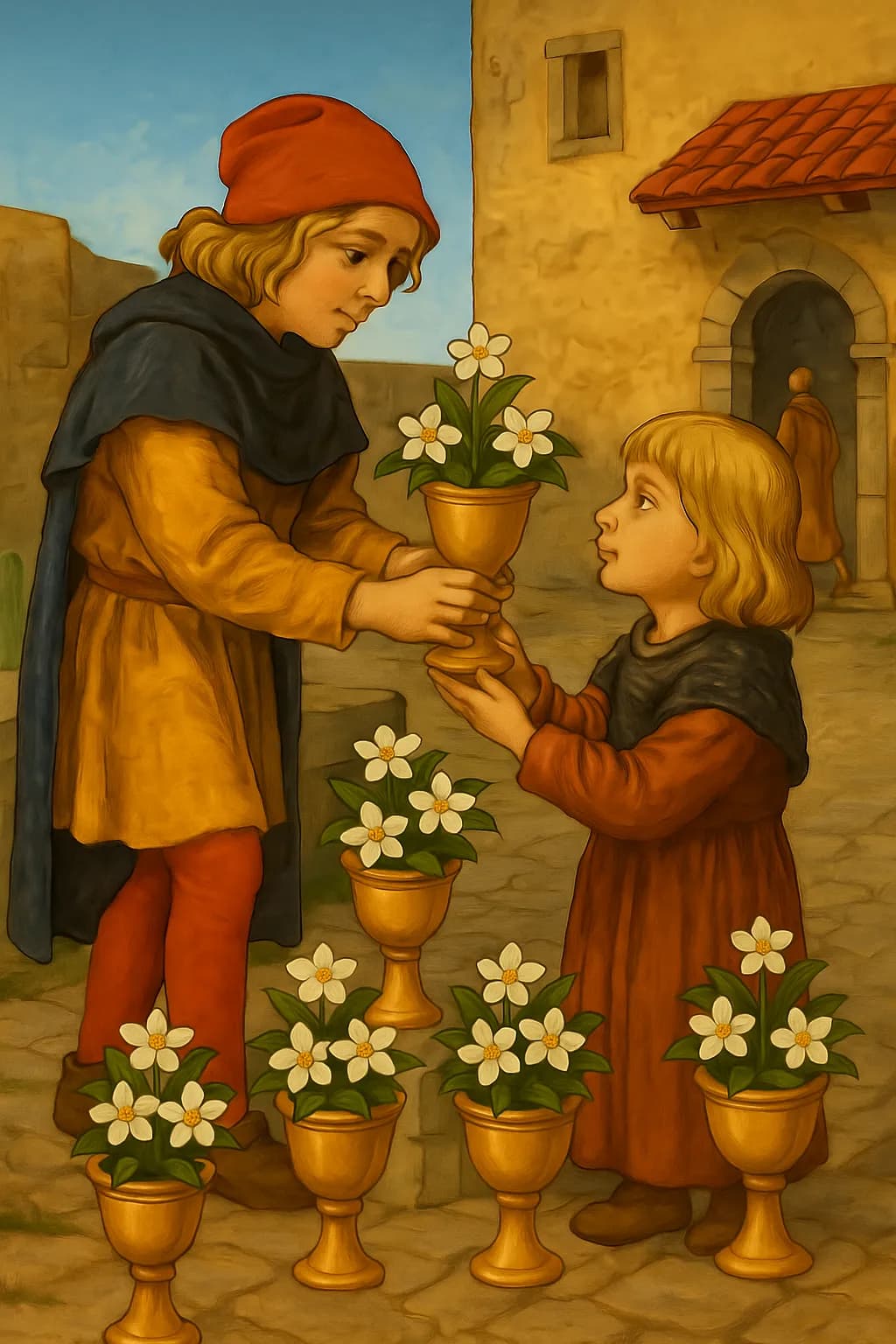
The Six of Cups is the card of memory, childhood, and kindness with nothing expected back. In the classic Rider-Waite-Smith image, in the courtyard of an old manor, a hooded boy bends toward a small girl and holds out a cup filled with white flowers. There are six cups in all, and they hold not wine but blooms: four stand in a row across the foreground, a fifth rests on a stone plinth to the left. A guardsman with a pike walks off into the depth of the yard, and the whole scene is washed in an even, golden light. The past here is not calling you back or asking anything of you. It arrives in the present on its own, with a gift in its hands.
CupsCups in this suit usually hold water — feelings that flow and shift; here flowers stand in for the water, a feeling that time did not carry off but rooted in place. The older child hands the cup to the younger one, and that is how everything we inherit from the past gets passed along: warmth, a skill, a family habit. The motion runs one way, and the giver wants nothing back. The departing guardsman is grown-up wariness leaving the frame: in this courtyard you can drop your guard and stop scanning the other person for threat. But the courtyard is walled, and that is the second half of the meaning — the sheltered place of childhood is wonderful as a source of warmth and cramped as a permanent address. Finally, the golden light is the filter of memory: a recollection always runs warmer than the life it came from, and the card warns you plainly about that distortion.
A message from a friend you haven't spoken to in ten years; a trip back to your hometown; an afternoon spent going through the family photo album; a smell or a song that drops you straight back into one specific childhood yard — the storylines of the Six of Cups are easy to recognize. They also include help from old acquaintances, an ex circling back, a class reunion, the itch to pull a long-abandoned hobby down off the shelf. What these situations share is one thing: the past is knocking at the present, and it's up to you what it becomes — a resource you can lean on, or a hideout where it's comfortable to dodge today's tasks. The card turns up at exactly the moment of that choice.
Upright Meaning
Reversed Meaning
What do you more often think about fondly — what's coming, or what already happened? The reversed Six of Cups turns up when the honest answer is "what happened": memory stops feeding the present and starts replacing it. Old message threads get reread for the third time instead of new conversations getting started, every new person loses by comparison to "the one," and any task in front of you meets the answer "things were better before." The pull to go back — to an ex, to your old city, to a former job — doesn't rest on it having been good there, but on it being familiar: nostalgia is good at passing itself off as love. Before you give in to it, call up not only the best moments but the specific reason you left in the first place — did that reason vanish, or did you just forget it? The deepest layer of the card is childhood scripts at the wheel: old grievances and roles from the family you grew up in still make decisions for the adult you've become, and then the work isn't with the nostalgia but with the script itself.
Six of Cups in love: going back and reminiscing are not the same thing
The card's most common storyline is a person from the past: an ex reaches out, a high-school crush likes your post, and an old feeling seems alive again. The sober test: are you good with who this person is today — or with the memory of who you were back then? For the single, the card is favorable in a different way: a relationship forms inside a warm, familiar circle — friends of friends, former classmates — and starts without performance, on easy terms. In a couple, the Six of Cups is about the tenderness of simple gestures: flowers for no reason, looking through old photos together, a trip back to the spot of your first date. What works isn't "romance" in the abstract but the reminder of where the two of you began — it settles the running tally of grievances better than arguing over who's right ever could.
Six of Cups in your career: your reputation works while you're not looking
At work the card returns what you've already built up. A former colleague pulls you into a project, a longtime client comes back, a referral arrives from someone you worked with five years ago — your old professional reputation keeps working without your involvement. The practical move is to go back through your earlier contacts: two or three short messages to former colleagues do more than a dozen blind applications. The second resource is skills from a "past life": a degree or a hobby that seemed buried suddenly slots into your current work. The card's trap is living off your former status — "back at that company I was a lead" doesn't pay for today's tasks; past achievements only count while you keep converting them into new results.
Six of Cups and health: go back to what already healed you
For your wellbeing the card points you to look for recovery not in some fashionable new method but in what once mended you before: recall what genuinely made you feel alive — cycling, swimming, long walks, drawing — and start with one such evening this week. Movement that comes from pleasure lasts longer than a workout gritted out through clenched teeth, because it doesn't run on willpower. Familiar surroundings help too: when you're worn out, an evening at your parents' or with old friends releases the tension faster than another evening with your phone. One signal is worth watching: "the way it was as a kid" slides easily into comfort eating and sweets — that kind of food masks the fatigue but doesn't remove its cause.
Six of Cups and money: debts come back, habits are inherited
With money the card is about returns: an old debt gets repaid, support arrives from family, a long-held skill or an abandoned project starts bringing in income again. Accepting help from those close to you is fine here — it's not a failure of self-reliance; the only thing to watch is not building it into your budget as a permanent line item. In decisions the card sides with the proven: tools and schemes that have already worked for you are safer right now than experiments. And the main move under this card is to audit your inherited money habits: spending or saving "the way it was done in the family" is childhood autopilot. Look at your last three financial decisions and ask whether they're yours — or your parents'.
Six of Cups: Combinations with other cards
Major Arcana
- The FoolCaring for children; recalling childhood; a trip to the places of your youth
- The MagicianActing on long-forgotten plans
- The High PriestessA secret from the past
- The EmpressProfit from a past investment
- The EmperorCaring for family or work
- The HierophantMeeting a former lover
- The LoversA relationship with someone from the past; an old passion reignited
- The ChariotRefusing to let the past be erased
- StrengthSelf-improvement
- The HermitDwelling on the past
- Wheel of FortuneNostalgia; memories
- JusticeInfluence over others; a reunion with old acquaintances
- The Hanged ManA past that has upended the present
- DeathBurying the past; oblivion
- TemperanceGrowing up
- The DevilChildhood fears; the shadow of the past; sins of youth; some things cast long shadows; vindictiveness
- The TowerA childhood trauma
- The StarHope that a childhood dream will come true
- The MoonThe delusions of youth; a hazy memory
- The SunA happy future
- JudgementShedding idealism; a past run-in with the law
- The WorldComing of age; a dream fulfilled
Wands
- Ace of WandsA chance to realize an old dream
- Two of WandsA hard stage of growing up; choosing a path for the future
- Three of WandsA long-standing relationship with a happy continuation
- Four of WandsGraduating from school or college
- Five of WandsAn old conflict; a conflict rooted in the past
- Six of WandsA final exam; a wedding
- Seven of WandsProblems building up over the years
- Eight of WandsNews from a childhood friend; word from the past
- Nine of WandsOld grievances that give no peace
- Ten of WandsPainful memories
- Page of WandsA childhood passion; a hobby
- Knight of WandsRelocation
- Queen of WandsA key family member with yin qualities
- King of WandsA key family member with yang qualities
Cups
- Ace of CupsA past love reignited
- Two of CupsOld ties; past arrangements
- Three of CupsPast happiness
- Four of CupsOld grievances; regretting the past
- Five of CupsA loss in the past
- Seven of CupsOld delusions
- Eight of CupsLeaving the past behind for good
- Nine of CupsA long-held wish
- Ten of CupsA family past
- Page of CupsYoung love
- Knight of CupsA longtime lover
- Queen of CupsA longtime lover
- King of CupsA longtime lover
Swords
- Ace of SwordsA long-held idea
- Two of SwordsStuck in between; the past is gone but the future hasn't come
- Three of SwordsOld wounds
- Four of SwordsHealing from the past
- Five of SwordsOld scores; revenge; a scandalous past
- Six of SwordsLeaving the past behind
- Seven of SwordsRegrets about the past
- Eight of SwordsOld fears
- Nine of SwordsNightmares of the past; a tormented conscience
- Ten of SwordsLosing the past
- Page of SwordsRejecting care
- Knight of SwordsA shattered idyll
- Queen of SwordsA cold childhood
- King of SwordsA hard childhood
Pentacles
- Ace of PentaclesOld money; an heirloom with a history; genetic memory
- Two of PentaclesPast debts
- Three of PentaclesA restorer
- Four of PentaclesBuried treasure
- Five of PentaclesA poor youth
- Six of PentaclesAn old loan
- Seven of PentaclesLong-ago investments
- Eight of PentaclesAn old job; a past project
- Nine of PentaclesPast investments
- Ten of PentaclesAn inheritance
- Page of PentaclesRecent schooling
- Knight of PentaclesRegression
- Queen of PentaclesA former homemaker
- King of PentaclesA former financier